Where to Sell Type Beats: BeatStars vs YouTube vs Your Own Site
There's no single right answer here, and any guide that tells you otherwise is simplifying a decision that actually has real consequences for your income. The platform you choose affects your fees, your traffic, your brand control, and your long-term leverage as a producer. Here's the honest breakdown of each option, what it costs, what it gives you, and who each one actually makes sense for.
The Three Models, Quickly
Before getting into specifics, it helps to understand what each option actually is:
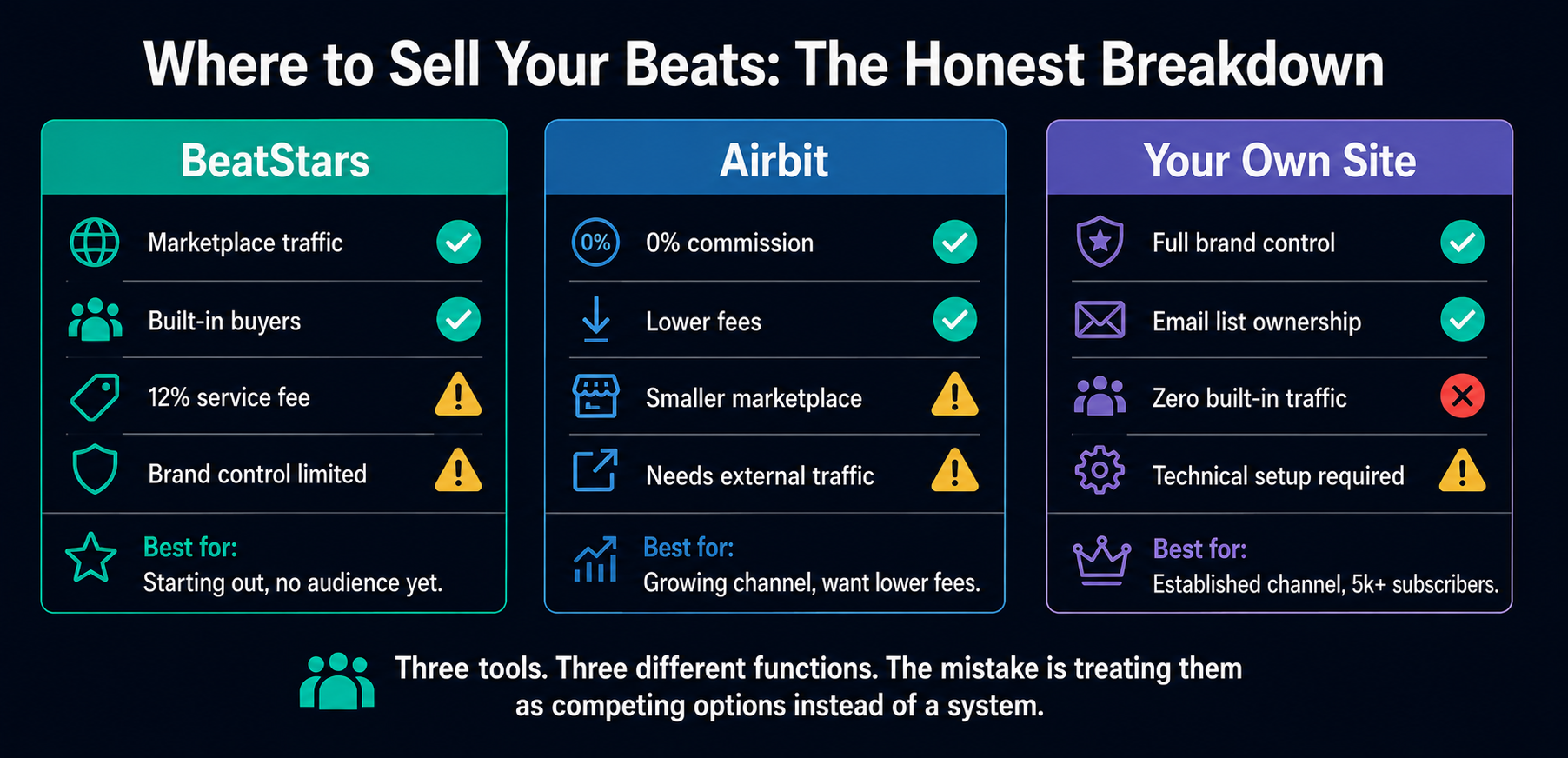
BeatStars (and Airbit, Traktrain): Dedicated beat marketplaces where artists already come to browse and buy. You get built-in traffic in exchange for fees, platform rules, and competition with every other producer on the same platform.
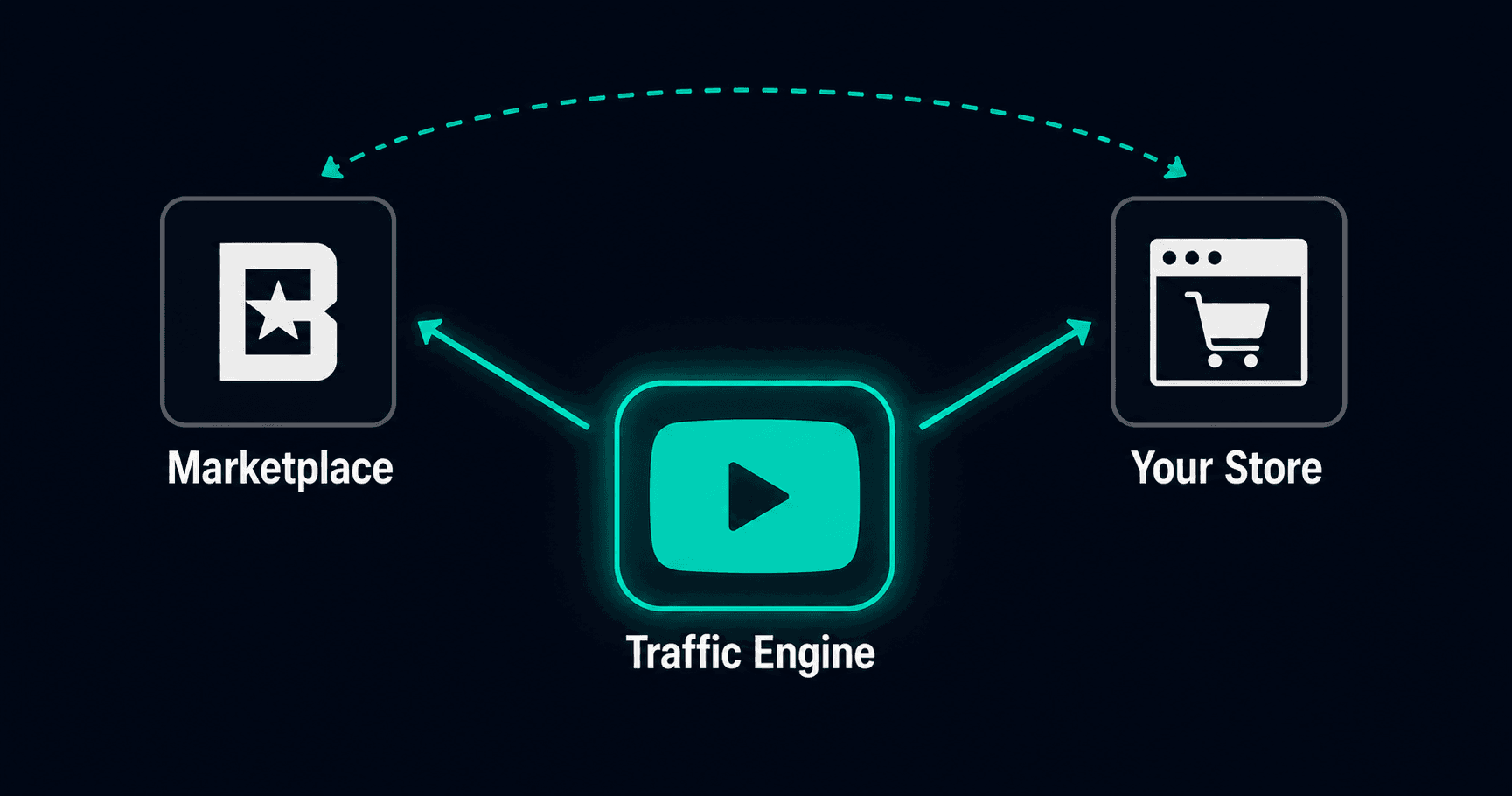
YouTube: Not a selling platform at all — it's a search engine and discovery tool. Artists find your beats here, then click through to buy somewhere else. YouTube is traffic infrastructure, not a store.
Your own website: Full control, no fees, your brand. But zero built-in traffic. You have to bring every visitor yourself.
Understanding this distinction is what makes the decision clear: these aren't three competing options you pick one from. They're three different tools that serve different functions in the same system.
BeatStars: The Default Choice, and Why That's Complicated
BeatStars is the largest beat marketplace in the world, with over 2 million registered users. It's where most artists start when they're looking for beats, which gives it something the other options don't have: built-in demand.
What BeatStars Actually Costs
The pricing structure has a layer of complexity that catches new producers off guard. BeatStars advertises zero seller commission, and technically that's true. What they don't advertise upfront is the buyer-side service fee.
When an artist finds your beat through BeatStars marketplace search and goes to checkout, they see a 12% service fee added to the purchase price. You as the seller can choose to absorb that fee yourself — meaning you take 12% less per sale — or let the buyer pay it, which creates a small but real friction point at checkout.
On the subscription side, BeatStars currently offers:
Starter: ~$1.67-2/month (billed annually). Unlimited uploads, zero commission on sales via your Pro Page, basic features.
Professional: ~$14.99/month. Adds a customizable website with your own domain, YouTube Content ID, merch and membership sales, access to their Creator Rights Agency.
The practical implication: if your traffic mostly comes from YouTube or social media and buyers go directly to your Pro Page (not through BeatStars marketplace search), you avoid the 12% service fee entirely. If BeatStars' own marketplace is driving your sales, the fee applies.
What BeatStars Does Well
The marketplace exposure is real. For producers who don't yet have a YouTube channel or external traffic source, BeatStars' internal search can surface your beats to artists who are actively shopping. It's the closest thing the beat world has to built-in organic traffic.
The licensing infrastructure is also genuinely good. Automated contracts, instant delivery, split payment options, Content ID registration — these are features that would take serious technical effort to replicate on your own.
What BeatStars Does Poorly
Competition is brutal. You're listed next to hundreds of thousands of other producers, many of whom are bigger, more established, and paying for promoted placement. The BeatStars marketplace rewards volume and advertising spend. Without either, organic discovery is slow.
Brand control is also limited. Your Pro Page is hosted on BeatStars' infrastructure. You're building your reputation on someone else's land.
BeatStars is right for you if: You're early in your journey, have little to no external traffic, and need a proven infrastructure with built-in buyers. Accept the tradeoff: you're renting space in a mall, and the mall owner sets the rules.
Airbit: The Leaner Alternative
Airbit, now owned by BandLab Technologies, is BeatStars' most direct competitor. The core difference comes down to fees.
Since the BandLab acquisition, Airbit eliminated marketplace commission fees on most transactions. The only costs you pay are standard payment processor fees — around 2.9% plus $0.30 per transaction via PayPal or Stripe. That's a meaningful difference compared to BeatStars' 12% service fee on marketplace sales.
Airbit's pricing tiers:
Free: 10 beat uploads, Airbit branding, limited features.
Gold ($7.99/month): 50 uploads, no branding, basic customization.
Platinum ($12.99/month): Unlimited uploads, full analytics, advanced features.
Diamond ($19.99/month): All features, priority support.
The Gold tier at $7.99 meaningfully undercuts BeatStars for producers who want to limit costs while testing the market.
The tradeoff: Airbit has a smaller marketplace than BeatStars. The built-in audience is smaller, which means fewer organic buyers browsing and discovering your beats. Airbit works better for producers who already have their own traffic source (YouTube, social media) and just need a reliable back-end to handle transactions — rather than producers relying on marketplace discovery.
Airbit is right for you if: You have existing traffic and want lower fees, or you want a cleaner brand experience without BeatStars' marketplace noise. It's infrastructure-first, not discovery-first.
Traktrain: The Curated Option
Traktrain is a smaller, more curated marketplace focused specifically on modern hip hop, trap, and adjacent styles. The free plan offers limited upload slots. Paid plans remove those limits and add scheduling, email capture, split payments, and analytics. Commission structure is similar to Airbit: minimal or zero on direct store sales, with fees applying in specific marketplace contexts.
The main argument for Traktrain is quality over quantity. Because it's more curated and smaller, there's less noise — but also less traffic. It tends to attract producers with a distinct aesthetic and artists who prefer browsing a more refined selection.
Traktrain is a secondary option rather than a primary platform for most producers. It's worth having a presence there as part of a wider distribution strategy, but not a place to rely on for main traffic.
YouTube: The Engine, Not the Store
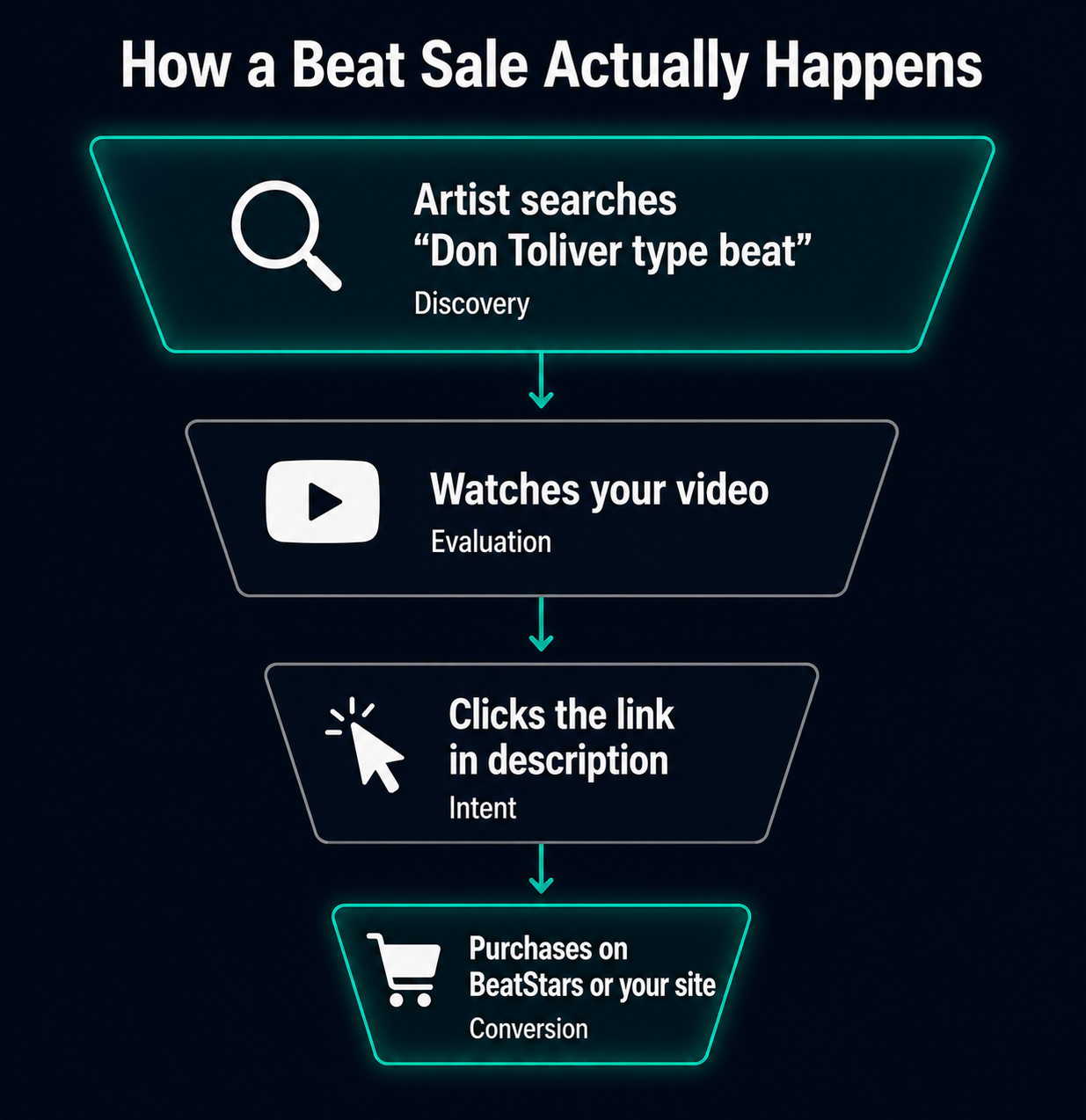
This is the most important thing to understand about YouTube in the beat-selling ecosystem: it is not where you close sales. It's where artists discover you.
YouTube has over 2 billion monthly active users and is, functionally, the world's second-largest search engine. When an artist types "Destroy Lonely type beat 2026" into YouTube, they're looking for a beat to buy. If your video ranks for that search, they find you, listen, and click the link in your description to your BeatStars, Airbit, or own-site store.
YouTube is the top of the funnel. Everything else is where the transaction happens.
Why YouTube Is Non-Negotiable for Type Beat Producers
A properly built YouTube catalog creates what nothing else in this space can: evergreen, compounding search traffic. A beat video you upload today can still be driving buyers to your store two years from now if it ranks for the right keyword. That's passive traffic with no ongoing cost.
The key metrics YouTube drives for beat sellers: impressions (how often your thumbnail appears in search and suggested results), click-through rate (how many people click your video), and ultimately — through your description link — conversions on your beat store.
YouTube also builds trust. An artist who finds your beat and clicks to your channel page is evaluating you as a producer before they spend money. A channel with consistent branding, dozens of videos, and a clear visual identity signals that you're a real, established producer — which directly affects whether they complete the purchase.
YouTube's Real Limitation as a Distribution Tool
YouTube won't process your beat sale. There's no cart, no license delivery, no contract — it's just video. The conversion chain requires an extra step: watch the video on YouTube → click the link → land on BeatStars or your site → complete the purchase. Every extra step costs you some percentage of potential buyers.
This is why description links and in-video CTAs (call-to-action cards, text overlays pointing to the store) are critical. You need to make the path from YouTube to purchase as frictionless as possible, because YouTube itself does nothing to close the sale.
YouTube's role in plain terms: Build a YouTube channel as your primary traffic acquisition asset. Use BeatStars, Airbit, or your own site to actually process transactions. One without the other is a broken system.
Your Own Website: Maximum Control, Maximum Responsibility
Building your own beat store means hosting it on your domain, handling your own payment processing (typically via Stripe or PayPal integration through tools like Sellfy, Shopify, or a custom build), managing your own licensing contracts, and bringing every single visitor yourself.
The Real Upside
No platform fees except standard payment processing (2.9% + $0.30 per transaction). Complete brand control. Customer data that belongs to you, not BeatStars. The ability to build an email list directly from your buyers and use it for follow-up campaigns. Full flexibility on how you present your beats, price your licenses, and structure your offers.
One stat worth knowing: email marketing consistently delivers the highest ROI of any marketing channel for digital product sellers. When someone buys a beat from your own site and gives you their email, you own that relationship. When they buy from BeatStars, BeatStars owns the customer relationship.
Over time, that list of past buyers is one of the most valuable assets a producer can build.
The Real Downside
Zero built-in traffic. None. Every person who visits your site has to be driven there by you — through YouTube, social media, email, paid ads, or some other channel. Running a store on your own website without a traffic source is opening a physical store in the middle of a desert.
There's also the technical overhead: setting up the site, keeping it functional, managing payment integrations, handling customer service. These are solvable problems, but they require time and some upfront investment.
Your own site is right for you if: You've already built a substantial external traffic source (especially YouTube) and want to stop giving 12% of your revenue to a marketplace. It's an upgrade move, not a starting point.
The Framework Most Successful Producers Actually Use
Here's the honest picture of how this works for producers who are making consistent money:
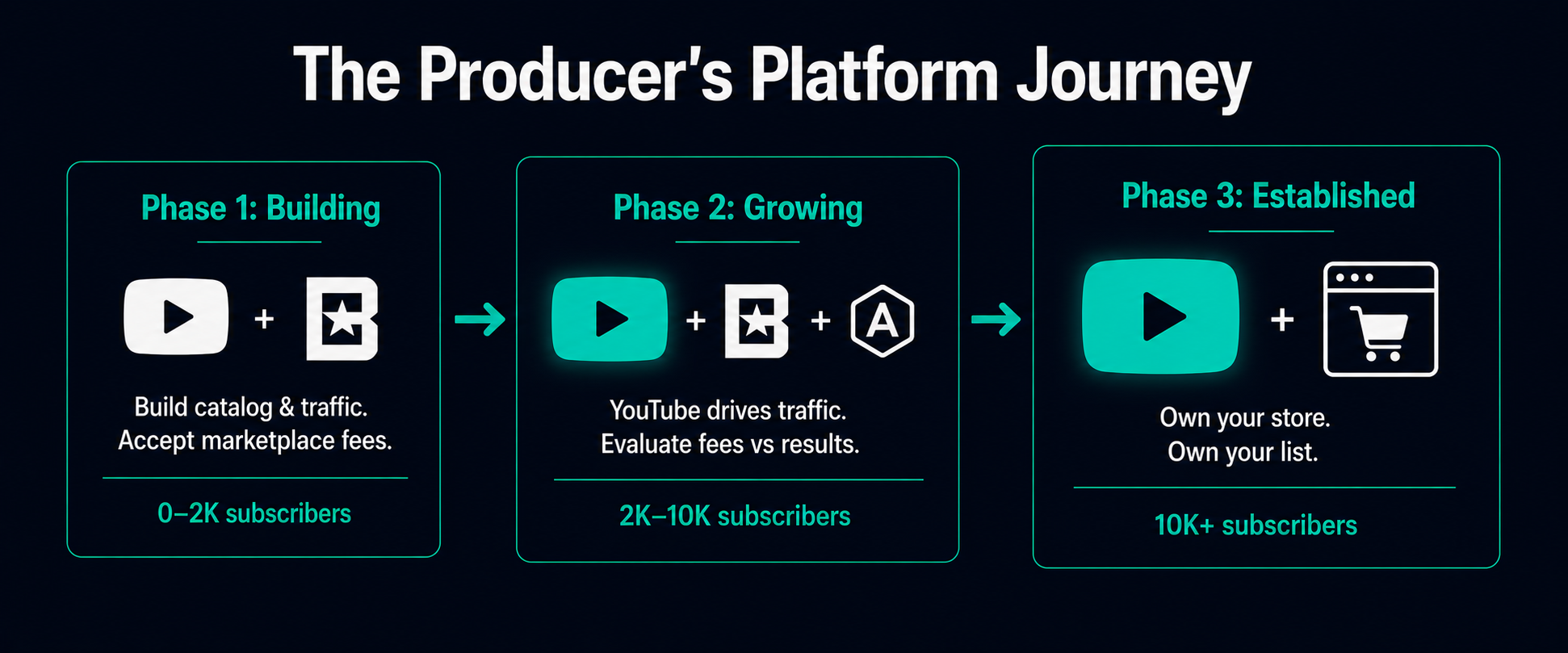
Phase 1 (Building): YouTube channel + BeatStars. You're building catalog and traffic simultaneously. BeatStars handles your infrastructure, YouTube drives discovery. Accept the fees as the cost of not yet having your own traffic.
Phase 2 (Growing): YouTube channel + BeatStars Pro Page + possibly Airbit as a secondary store. Your YouTube channel is now sending real traffic. You're evaluating whether the BeatStars marketplace fee is justified by the incremental sales it generates, or whether most of your buyers are coming from YouTube anyway (in which case you could switch to the lower-cost Airbit for the same result).
Phase 3 (Established): YouTube channel + your own site, with BeatStars maintained as a presence but not the primary store. The email list from your own site becomes a genuine revenue asset. You're running promotions to past buyers, announcing new beats before they go live publicly, and capturing the full transaction value instead of paying marketplace fees.
The producers who skip Phase 1 and go straight to their own site without a traffic source typically struggle for a long time before they figure out why sales aren't coming. The producers who stay in Phase 1 indefinitely leave money on the table because they never build the infrastructure they own.
Quick Decision Guide
The One Thing That Matters More Than Which Platform You Choose
All of the platform decisions above are secondary to one fact: YouTube is your traffic source, and without it, none of the marketplaces perform well for an independent producer.
BeatStars with 50 subscribers on YouTube and no external traffic will generate almost no sales from organic marketplace discovery alone. BeatStars — or your own site — with a YouTube channel driving 50,000 monthly views can generate real, consistent income.
The platform you sell on matters. But where your buyers come from matters more.
Keywords: where to sell type beats, BeatStars vs Airbit, type beat platform comparison, sell beats online 2026, BeatStars fees, Airbit vs BeatStars, type beat website, beat marketplace comparison