How to Sell Type Beats on YouTube in 2026: Complete Guide
If you've been uploading beats consistently for months and still can't break 50 views per video, you're not doing something wrong. You're just missing a few things that most guides skip over. This is the complete breakdown of what actually works for type beat producers on YouTube in 2026, from niche selection to publishing strategy, written for people who want real results and not another list of obvious tips.
Why YouTube Still Matters (More Than Ever) for Beat Sellers
YouTube isn't just a video platform. For a type beat producer, it's a search engine with two billion monthly active users, and it's the primary discovery channel for artists looking for instrumentals. BeatStars alone has reported over $250 million in producer payouts, and YouTube drives billions of type beat views every year.
The math is simple: no YouTube presence, no traffic. No traffic, no sales. Your BeatStars or Airbit page can be perfectly set up, but without a steady stream of people landing on it from YouTube search, you're essentially running a shop with the door locked.
The challenge isn't the platform. The challenge is that YouTube has become brutally competitive for type beat producers, and most of them are making the same avoidable mistakes.
Step 1: Pick Your Niche Strategically
This is where most producers either win or lose before they upload a single video. The choice of which artist to reference isn't a creative decision, it's an SEO decision, and it deserves serious thought.
The Five Keyword Layers
Every type beat keyword falls into one of five layers. The right upload strategy should target layers 2 to 4. Layer 1 (head terms like "Drake type beat") is unwinnable without catalogue scale. Layer 5 (pure mood) attracts listeners, not buyers.
In practice, this means:
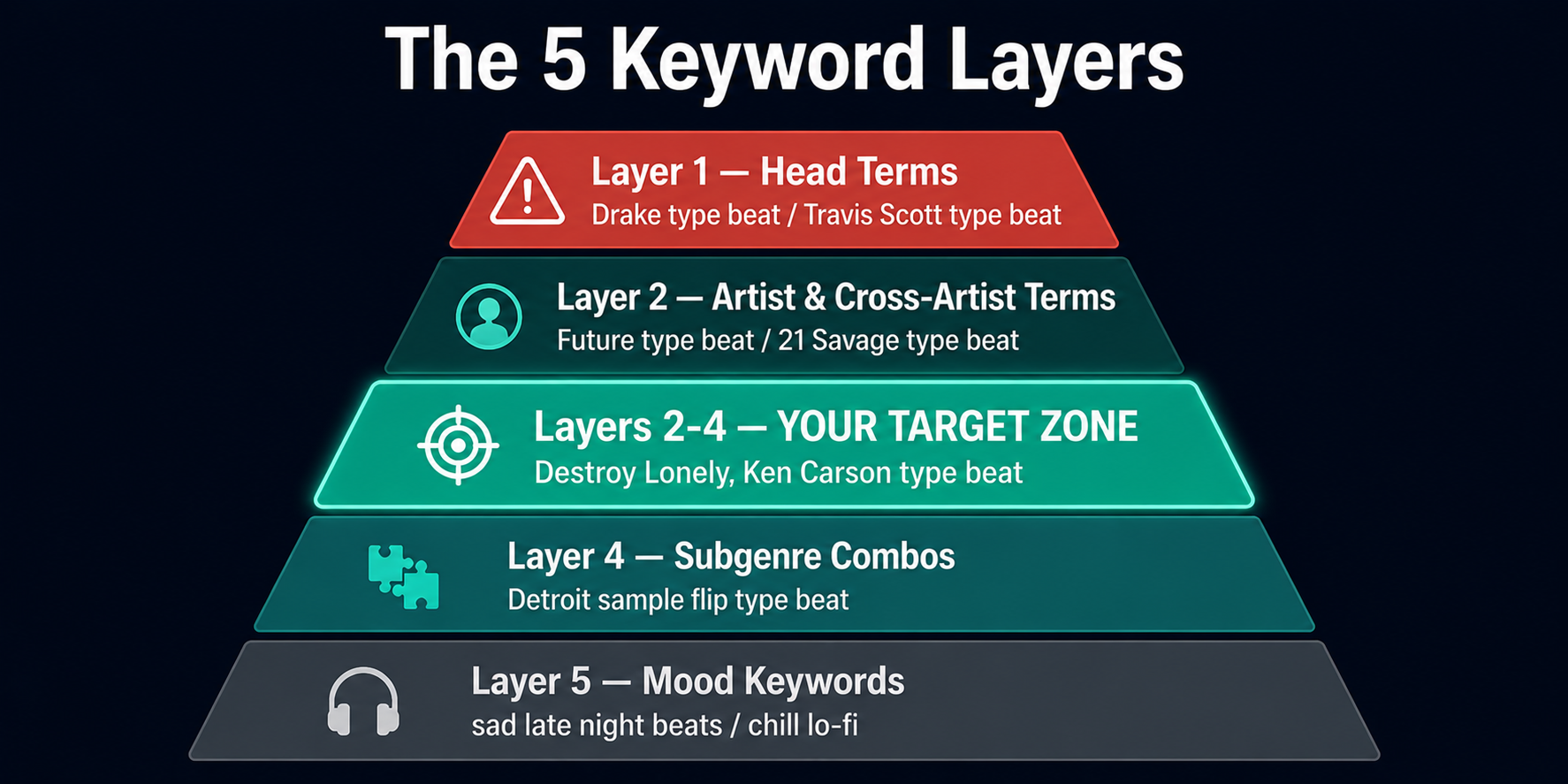
Layer 1 (avoid early on): "Drake type beat," "Travis Scott type beat" — millions of results, dominated by established channels.
Layers 2-4 (your target zone): "Destroy Lonely type beat," "Ken Carson type beat," niche subgenre combos like "Detroit sample flip type beat" — real search volume, far less saturation.
Layer 5 (wrong audience): "sad late night beats," "chill lo-fi instrumental" — these attract listeners, not artists with wallets open.
How to Spot an Untapped Artist Before Everyone Else
An outlier beat video is one performing at 3x to 10x its own channel's median views. When you find a channel where one video is massively outperforming everything else, and that video targets a specific artist or subgenre, you've found a signal worth acting on. That's where you want to plant your flag before the niche gets crowded.
One approach is the Outlier Detection Method: find three to five type beat channels similar in size to yours, look at which of their videos are overperforming their average, and target that exact artist or subgenre combination in your next uploads.
Tools like Typeflick include a Niche & Artist Explorer that does exactly this kind of analysis automatically, helping producers identify which styles and keywords offer the best opportunity before committing to a content direction.
Step 2: Build a Channel Identity That Doesn't Look Generic
The vast majority of type beat channels look identical. Black background. Artist photo. White text. Generic sans-serif. Same layout, different producer tag.
That's a problem, because thumbnails influence CTR, recommendations, and long-term channel growth. They act as the gateway to every other metric that matters.
When every thumbnail looks the same, your CTR suffers because there's no visual reason to click on yours over the next one. And CTR is one of the clearest signals YouTube uses to decide whether to show your video to more people.
What Makes a Type Beat Thumbnail Actually Work
YouTube thumbnail design best practices for 2026 focus on mobile readability, high-quality images, emotional storytelling, and testing multiple designs.
For type beat channels specifically:
Consistency over complexity. Your thumbnails don't need to be works of art. They need to be recognizable as yours from a distance. Pick a color palette, a layout structure, a font combination, and stick to them across every upload. This builds channel authority over time because returning visitors immediately know which videos are yours in a feed.
High contrast, single focal point. Minimalist thumbnails are often the most effective. One image, one text element (the artist name + "type beat"), clean background. Anything that requires reading is too much.
Design for mobile first. Over 70% of YouTube views happen on mobile devices, so designing on a large monitor without testing at a small scale is a costly mistake.
The issue most producers face is that creating decent thumbnails takes time, requires design skills they may not have, and the inconsistency between uploads kills the brand coherence they're trying to build. This is exactly one of the problems Typeflick solves: AI-generated thumbnails that maintain a consistent visual identity across your entire catalog, without Photoshop or Canva, and without spending 20 minutes per upload on something that should take 20 seconds.
Step 3: Master YouTube SEO for Type Beats
YouTube SEO for beats is different from general YouTube SEO. The search intent is hyper-specific: an artist needs a beat that sounds like a particular artist, in a particular style, at a particular tempo. Your metadata needs to speak directly to that intent.
Title Formula That Works
The most battle-tested title format for type beat videos in 2026 is:
[Artist Name] Type Beat [Year] | [Mood/Style] [Genre] InstrumentalExample: Destroy Lonely Type Beat 2026 | Dark Melodic Trap Instrumental
Including the year matters because artists searching for beats want current sounds, not something from three years ago. Including the mood and subgenre opens you up to secondary search queries that bring in additional traffic beyond the primary artist name.
Some producers add "(Free)" to the title strategically, as these are common search terms used by artists looking for beats.
Description Architecture
Your description has two jobs: help YouTube understand what the video is about, and convert viewers into buyers.
A proven structure:
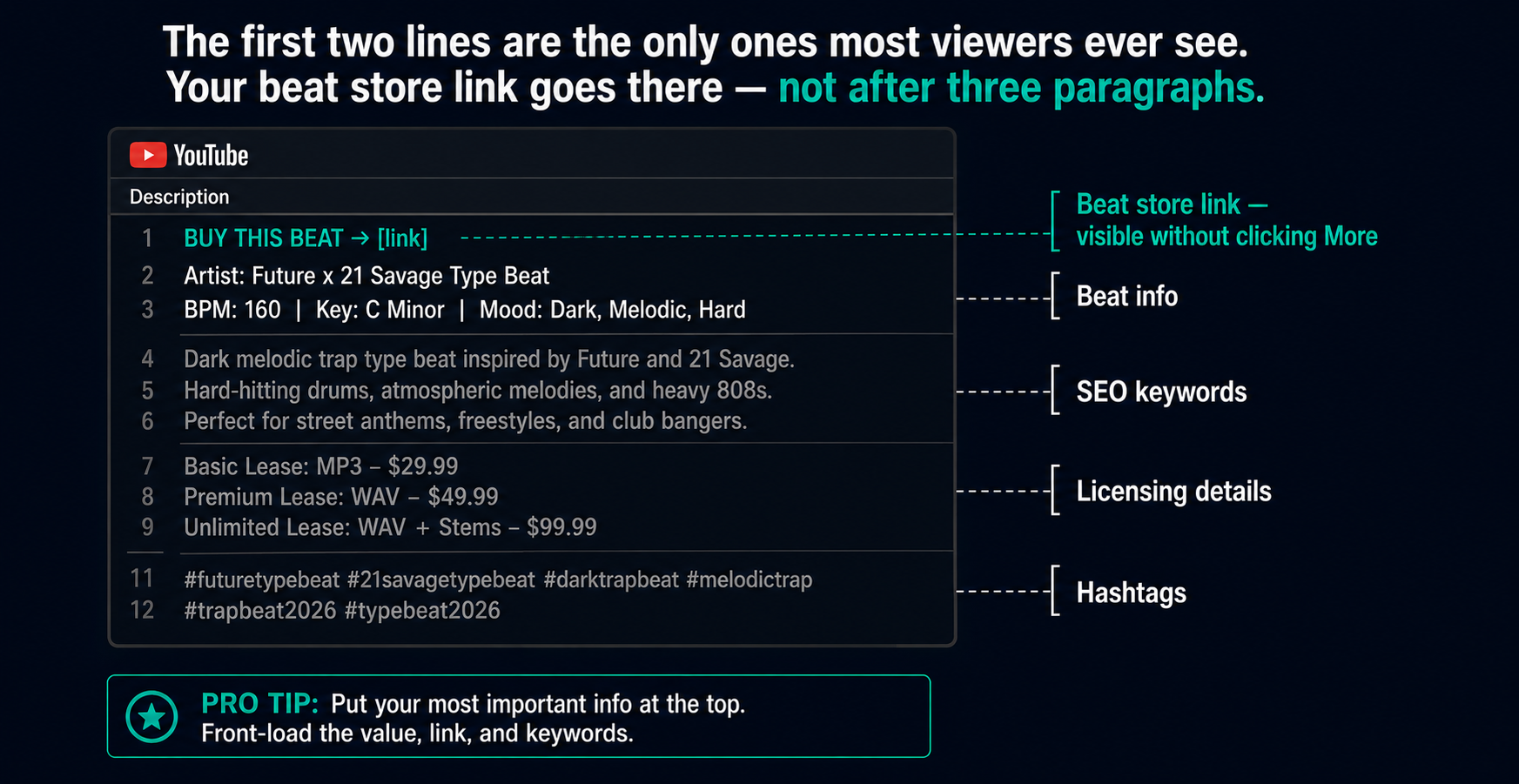
First two lines (visible without clicking "more"): artist name, mood, BPM, key, and your beat store link
Keywords paragraph: a natural-language sentence weaving in your main keyword variations
Licensing info: what leases you offer, price points, what each includes
Beat store link (again), social links
Hashtags at the bottom
The first two lines are critical. Most viewers won't click to expand the description, and YouTube weights the first 100-150 characters heavily for indexing.
Tags: Less is More
Stop stuffing 500 characters of tags hoping something sticks. Use 8-12 focused, relevant tags. Your main artist + "type beat," the genre, the mood, relevant related artists, and one or two broader category tags. That's it. Tag relevance matters more than quantity.
Step 4: Create Videos That YouTube Actually Recommends
Here's the part most type beat guides skip entirely: the video itself has a direct impact on how well YouTube distributes your beat.
Watch Time and Retention
The YouTube algorithm in 2025 and 2026 favors channels that publish on a sustainable schedule, keep viewers watching, and maintain strong retention. For a type beat video, retention largely depends on how engaging the beat is from the first eight bars. If the intro is too long, viewers drop off before the hook, and YouTube reads that as a bad video.
Keep intros short. Lead with the most compelling part of the beat. Most producers make the mistake of starting with 8 bars of background noise before anything interesting happens. Artists searching for beats will leave in the first 15 seconds if they don't hear something worth staying for.
Video Quality
Your video doesn't need to be cinematic. It needs to be clean, consistent, and not look like it was exported at 240p in 2014. At minimum: 1080p export, crisp audio (this is a music product, audio quality is non-negotiable), and a thumbnail image that matches your brand system.
The visual that appears in the video itself should be the same as your thumbnail. Channel coherence across the thumbnail preview and the actual video reduces the sense of visual bait-and-switch that increases viewer drop-off.
Step 5: Get Your Publishing Strategy Right
This is where a lot of producers waste time or accidentally damage their channels.
How Often Should You Actually Post?
What tends to work across channels is this: consistency + strong average view duration + a clear content system outperform raw upload frequency every time.
Daily uploads are not the answer for most producers. Posting one well-optimized beat three times a week beats posting five poorly-packaged beats every day. The key word is "optimized" — and that means every video needs proper metadata, a strong thumbnail, and clean video packaging, not just whatever you throw together in ten minutes before hitting publish.
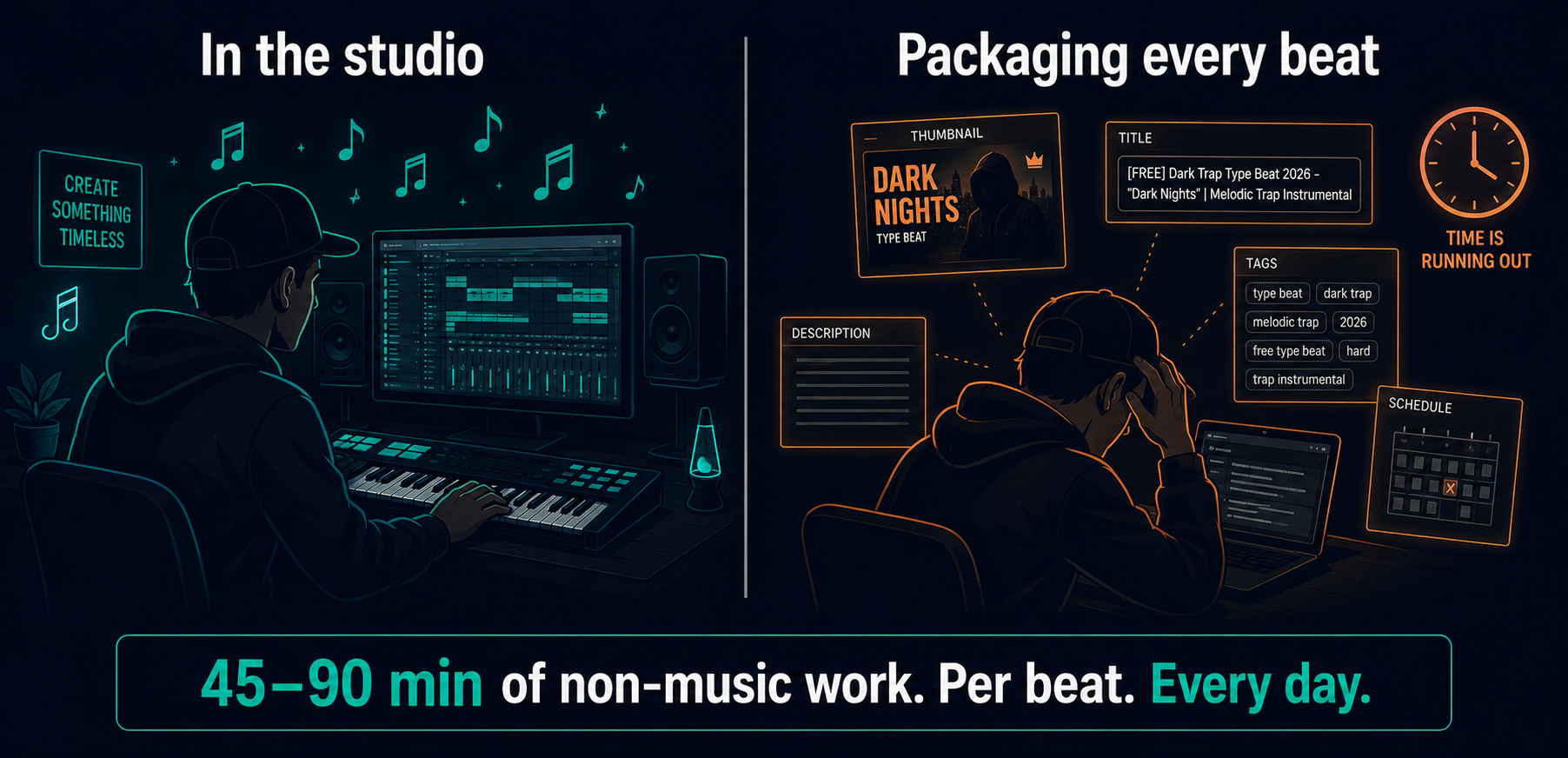
The practical problem: if you're producing 10-15 beats per week (which is normal for serious producers), the packaging overhead becomes a bottleneck. Either you publish everything and the quality of optimization suffers, or you cap your output. Neither is a good answer.
This is the core problem Typeflick was built to solve. Upload your audio file, and the platform handles the full packaging pipeline: beat-to-video conversion, SEO-optimized title and description generation, AI thumbnail creation, and scheduled publishing directly to your YouTube channel. A producer running at full output in the studio can maintain a full, consistent publishing schedule without spending hours on the operational side of it.
Timing Your Uploads
YouTube has the most data to work with in the first 24-48 hours after publishing, so the time you publish can affect how much initial momentum a video builds. It does not settle anything long-term — YouTube's own guidance is that publish timing helps early viewership without determining how a video eventually performs.
Uploading between 2:00 PM and 4:00 PM Eastern Time is a commonly cited window because it captures North American viewers in the afternoon and European audiences in the evening. For type beats specifically, your audience skews toward young artists who are active late afternoon and evening, so posting mid-afternoon gives your video time to index before peak activity hours.
The smartest approach: check your own channel analytics under "Audience," look at when your subscribers are most active, and schedule your uploads one to two hours before that window. Let the data tell you, not a generic guide.
Scheduled Publishing: Why You Should Be Using It
Batch-producing content is one of the most efficient ways to run a beat channel. Process several beats in one session, then schedule them to go live over the following days at optimal times. Your output looks consistent to the algorithm and to subscribers, even when you haven't been at your computer for two days.
This is a built-in feature in Typeflick, where you set the publication date and time for each video and it goes live automatically on YouTube. No manual intervention, no forgetting to hit publish at the right moment.
Step 6: Convert Views Into Beat Sales
Views don't automatically mean sales. Mobile streaming accounts for roughly 65% of beat discovery. Most people hearing your beat for the first time are on their phone, in a casual listening environment, and they're not going to remember to come back and buy later unless you make it impossible to miss the path to purchase.
Your Description Link Has to Be First
The beat store link needs to be the first thing in your description, before anything else. "Buy this beat: [link]" on the very first line. Not buried after three paragraphs of keywords.
The Video CTA
In the video itself, include a visual overlay or text card within the first 30 seconds pointing to the beat store. Most viewers won't read the description. You need the call to action in the video.
Channel Branding as a Trust Signal
Artists who find your beat and consider buying don't just listen to the one video. They check your channel. If your channel looks messy, has inconsistent thumbnails, a weak about section, or five subscribers, they're less likely to complete the purchase. Visual consistency across your catalog builds trust before they've even checked your prices.
This is one of the compounding advantages of running a consistent thumbnail system from day one. Over time, a catalog of 50+ videos with coherent branding reads as authority. It signals that you're serious, that you've been doing this for a while, and that buying a license from you is a safe transaction.
The Full Stack for a Type Beat Channel That Actually Grows in 2026
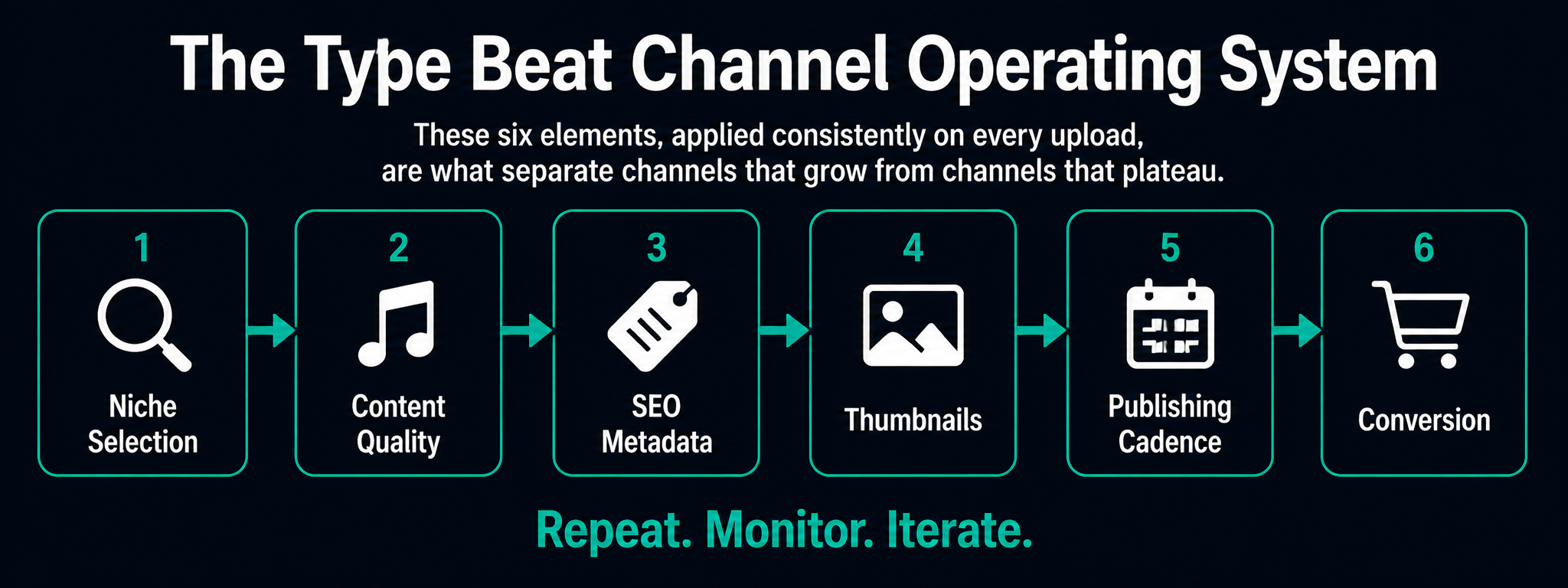
Let's put this together into a practical operating system:
Niche selection: Use outlier detection to find artist-subgenre combinations with real search volume and manageable competition. Revisit quarterly.
Content: Make the beat itself engaging from bar one. Short intros, hook-led structure, high audio quality.
SEO metadata: Title formula with artist name, year, mood, and genre. Description with store link first, keyword-rich paragraph, licensing details. 8-12 focused tags.
Thumbnails: Consistent visual system across every upload. High contrast, single focal point, designed for mobile.
Publishing cadence: 3-4 times per week at minimum, timed to your audience's peak activity window. Scheduled in advance through tools like Typeflick so you're not managing the logistics manually.
Conversion: Beat store link first in description. Visual CTA in the video. Clean, coherent channel page.
Monitoring: Check analytics weekly. CTR, watch time, impressions. When a video overperforms, look at why and replicate. When something underperforms, don't delete it — mark it for reference and adjust your next upload.
One Last Thing
The producers who grow consistently in 2026 aren't necessarily the ones with the best beats. They're the ones who treat every upload like a product launch: right niche, right packaging, right timing, right CTA. The good news is that most of that work can now be automated.
If you're serious about turning your studio output into a consistent YouTube presence without the packaging overhead eating your creative time, Typeflick is the tool built specifically for that gap. Beat-to-video conversion, SEO metadata, thumbnail generation, and scheduled publishing — the entire post-production pipeline, handled automatically, so you can stay in the studio and let the channel run itself.
Keywords: how to sell type beats on YouTube, type beat SEO 2026, sell beats online, YouTube type beat strategy, type beat channel growth, beat producer YouTube tips, type beat keywords, scheduled YouTube publishing for producers