
How Often Should You Upload Type Beats? (The Data Says It's Not Daily)
Every type beat guide says the same thing: upload every day, grind, never stop. Producers who follow this advice burn out after three months, their beat quality drops, and their views collapse faster than they grew. Some of them quit entirely.
The advice isn't completely wrong — but it's incomplete in a way that causes real damage. Here's what the data actually says, and what the producers who are growing consistently in 2026 are doing instead.
What "Daily Uploads" Actually Does to a Type Beat Channel
The theory behind daily uploads is simple: more content means more chances to rank in search, more videos means a bigger catalog, more uploads means the algorithm thinks you're active. All of this is technically true.
The problem is what daily uploads require in practice. A type beat producer making 10-15 beats per week and uploading every day has to handle beat-to-video conversion, thumbnail creation, SEO-optimized titles, descriptions, tags, and scheduled publishing for every single upload — on top of actually making the music. That's 45-90 minutes of non-creative work per upload, every day, while also trying to produce quality beats.

What happens in the real world: either the beats get rushed, or the packaging gets rushed, or both. And both outcomes hurt.
The YouTube algorithm in 2025 and 2026 stopped judging channels on individual videos and started judging channels as a whole — looking at patterns of viewer satisfaction across the catalog. A string of low-retention videos (because the beats were rushed) signals to the algorithm that the channel is declining. When quality of optimization suffers (sloppy titles, generic thumbnails, weak descriptions), the videos don't rank for the searches that would have converted to buyers. The result is a channel that's posting daily but getting fewer views than a channel posting three times a week with proper execution.
This isn't speculation. Channels from every niche show the same pattern: when daily upload pressure causes quality to slip, the algorithm pulls back distribution. The views that came from grinding don't come back when you grind harder — they come back when the quality signal improves.
What the Research Actually Shows
VidIQ analyzed over 5 million YouTube channels between June 2024 and June 2025. The headline finding that most guides cite: channels uploading 12 or more times per month grow their views 53% faster and gain 66% more subscribers than those posting 1-3 times monthly.
That sounds like a case for daily uploads. But the same dataset contains a more important finding: consistency beats frequency. Channels with a regular, predictable upload schedule see faster growth than channels that post erratically — even when the erratic channels post more total videos.
Read that again: posting one video every Tuesday at 2pm will grow your channel faster than posting three videos one week and nothing for the next two weeks — even though the second approach produces more content.
Your audience learns your pattern. When people can predict when you'll post, they come back for it — and a channel that goes quiet for two weeks after six weeks of daily uploads has to win that habit back. YouTube's own guidance is that upload frequency alone does not drive growth, which matches what most producers find: it is the sustainable rhythm that compounds, not the burst.
The third finding from the data is the one that should drive every type beat producer's strategy: quality beats frequency. One excellent video per week consistently outperforms three mediocre videos per week. YouTube's algorithm prioritizes viewer satisfaction — watch time, retention, CTR, return views — over raw upload volume.
The Type Beat Niche Is Specifically Search-Driven
This matters more for type beat channels than for most YouTube niches, and here's why.
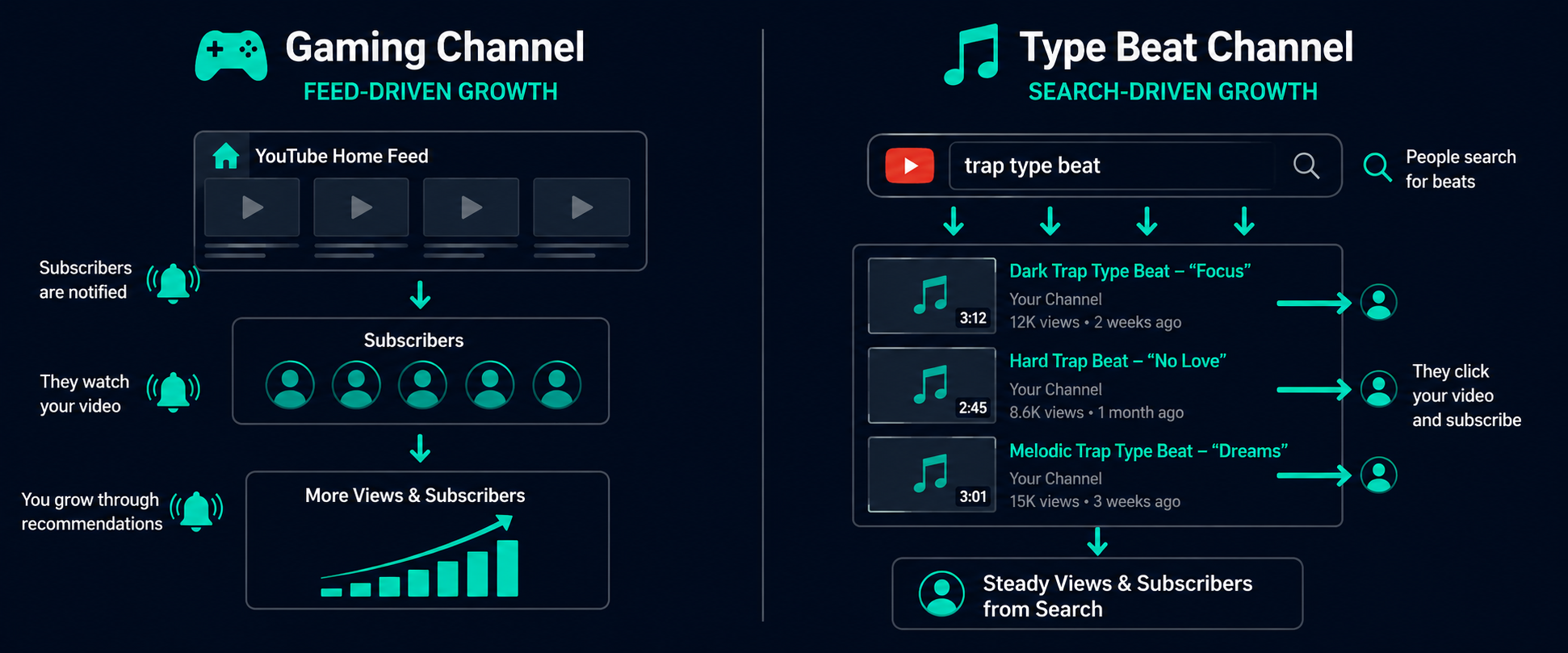
A gaming channel or a vlog-style channel depends heavily on subscribers watching new content shortly after it goes live. The "feed-driven" model rewards frequency because you need to keep showing up in subscriber notifications.
Type beat channels are fundamentally different. The primary traffic source is search — artists searching "Travis Scott type beat 2026" or "Don Toliver melodic type beat." Search traffic doesn't care when the video was uploaded. It doesn't matter if you uploaded it yesterday or 14 months ago. What matters is whether the video ranks for the keyword.
This means a well-optimized type beat video is an asset that generates traffic passively for years. A channel with 200 properly-optimized videos from two years ago can drive more monthly traffic than a channel that uploads daily but doesn't optimize each video properly. The catalog compounds — but only if each video is doing its job in search.
This completely changes the calculus on upload frequency. For a type beat channel, uploading 5 properly-packaged beats per week beats uploading 7 poorly-packaged ones — because the 5 good ones will keep generating search traffic long after the 7 bad ones have been buried.
A channel posting 2 long-form videos per week produces 104 videos per year. Each properly-optimized video is a searchable asset that generates views and subscribers indefinitely. At an average of 5,000 views per video, that's a 520,000-view catalog in year one — from search traffic alone, compounding year over year.
What the Top Type Beat Channels Actually Do
Looking at the upload patterns of the highest-performing type beat channels in 2026 reveals a consistent picture that contradicts the "post every day" advice.
SOGIMURA (168K subscribers, 1.1K videos): Their top-performing videos — the ones generating 20K-30K+ views — aren't clustered around periods of daily uploads. The channel maintains a steady rhythm of several uploads per week, but the standout performers are clearly videos where extra care went into the thumbnail (distinctive artistic visuals rather than generic rapper photos) and title SEO.
Tkd Beats: Their 1.3M-view "Travis Scott Type Beat - KICKED OUT" is a single video that dwarfs everything around it in view count. It's not a channel that wins through daily volume — it's a channel where one well-targeted, well-packaged video created a permanent traffic asset. The title references a specific album ("JackBoys 2 Type Beat 2025") — a deliberate SEO decision that attracted highly-intent buyers, not a product of posting more often.
MakDouble: Their 21 Savage x Drake type beat videos pulling 50K-100K+ views are built on title architecture (two cross-referenced artists, genre tags, year) and thumbnail execution — not on posting cadence. The packaging is the differentiator.
The pattern across every high-performing type beat channel: the biggest videos are wins of execution, not wins of frequency. The channels that grow consistently post frequently and package every video properly. Channels that post frequently without proper packaging get the grind without the results.
The Burnout Problem Is a Real Data Point
A 2024 survey found that 71% of YouTube creators have experienced burnout — and excessive upload pressure is a primary cause. For type beat producers, this stat carries extra weight because the burnout doesn't just kill the channel, it kills the love for making music.
The producer testimony on this is consistent. From Reddit's r/trapproduction, the same pattern appears repeatedly: producer commits to daily uploads, sees initial growth, starts rushing beats to hit the schedule, quality drops, views drop, motivation collapses, producer takes a break or quits entirely. Some never come back.
One producer put it directly: "I find that if I have to make music every day, it becomes a fast track to burnout eventually." Another: "I'm scared that I will lose that love and making music will almost become a job for me."
Daily uploads as a permanent strategy — not a launch sprint, but an ongoing practice — have a documented failure mode. The producers who are still growing at year three are not the ones who posted every day for three years. They're the ones who found a sustainable rhythm and kept it.
The Right Cadence: What the Numbers Support
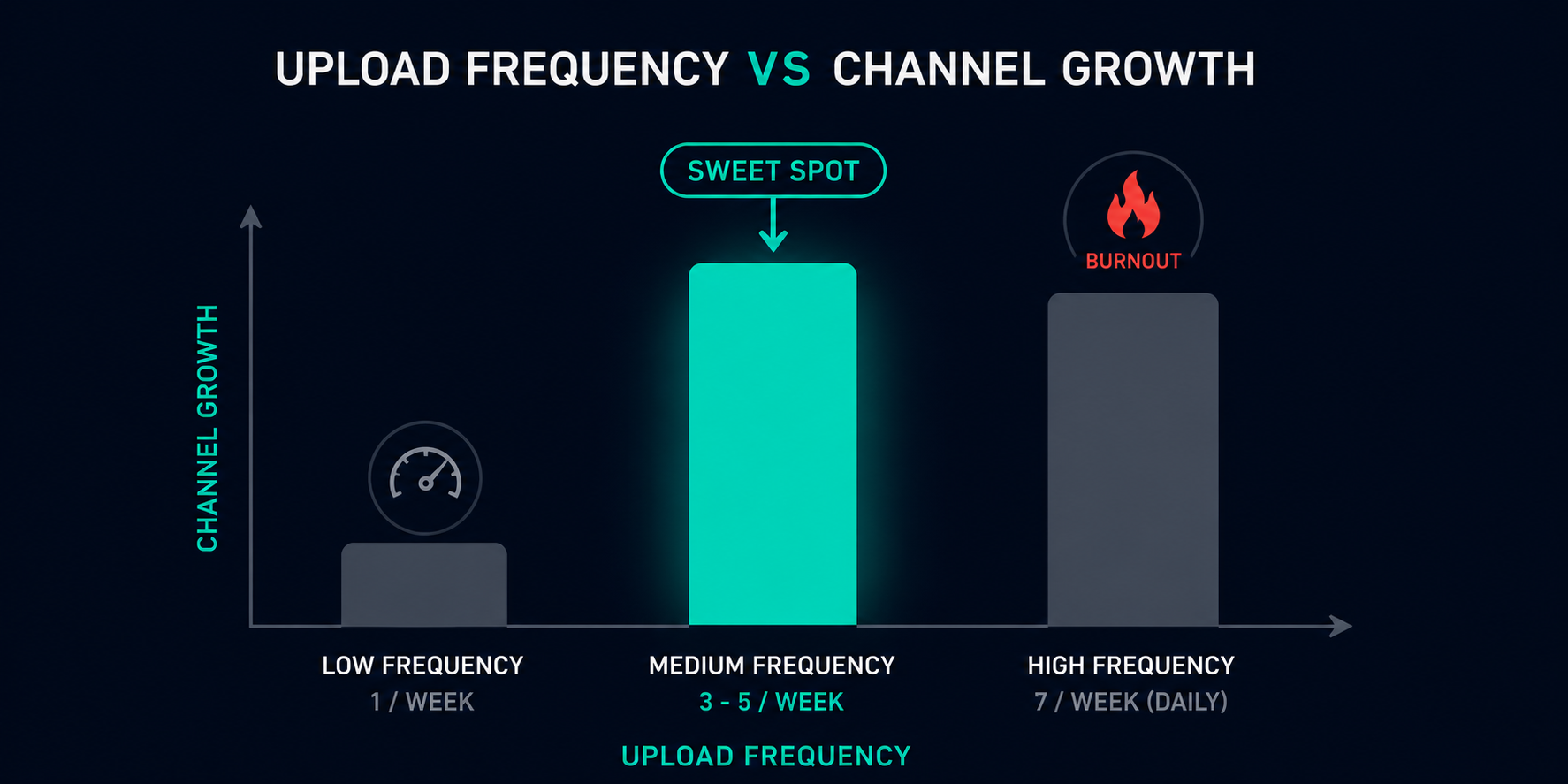
For type beat channels specifically, based on the search-driven nature of the niche and the data on consistency vs. frequency, the cadence that makes the most sense is 3 to 5 properly-packaged videos per week.
Here's why that range:
3 videos per week minimum keeps the algorithm's perception of your channel active, builds catalog at a meaningful rate (156 videos per year), and is achievable without sacrificing optimization quality on each upload.
4-5 videos per week is the sweet spot for producers making 8-12 beats per week who want to maintain growth without burning out. At 4 per week, you're publishing 208 videos per year — a catalog that, if properly optimized, compounds into substantial passive search traffic within 18-24 months.
7 daily uploads is only sustainable if the entire post-production pipeline — video creation, thumbnail, metadata, scheduling — is either automated or handled by someone else. For most independent producers, it isn't. And when the pipeline gets cut to save time, the optimization suffers and the catalog underperforms.
The quality threshold matters more than the number. Each video needs:
A proper SEO title following the formula (license signal + artist name + year + beat name + secondary artist/genre tag)
A consistent thumbnail that fits your channel's visual system
A description with the beat store link first, keyword-rich content, and licensing info
The right tags
Scheduled at an optimal time relative to your audience's activity window
If you can do all of that at 7 uploads per week, upload 7 times. If you can only do all of that at 4 uploads per week, upload 4 times. The cadence that produces properly-packaged videos is always better than the cadence that produces more videos.
Batching: How to Post Consistently Without Being Chained to a Daily Schedule
The practical answer to the "how often" question isn't about the number — it's about the system.
Producers who grow consistently without burning out almost universally use some form of batching: producing several beats in concentrated creative sessions, then handling all the packaging in a separate session, and scheduling the uploads to go out over the following days at optimized times.
This approach separates the creative work from the operational work. Instead of going from DAW to YouTube packaging every single day, a producer can spend two days making beats, one session packaging everything, and let scheduled publishing handle the rest. The channel looks active and consistent to the algorithm. The producer isn't grinding packaging tasks every morning.
The challenge is that even batched packaging is time-consuming if done manually. A 4-beat batch with proper title, thumbnail, description, tags, and scheduling for each video is several hours of work. For producers running at higher output, this is where the operational overhead either caps their volume or forces quality trade-offs.
This is the specific gap Typeflick was built to close — handling the full post-production pipeline automatically for each beat, so the batching workflow becomes: upload audio files, set publication dates, let the platform generate the packaging and schedule the uploads. The creative output and the channel activity stay in sync without the operational grind limiting either one.
The Actual Answer
Upload as often as you can properly package each video. For most independent type beat producers, that's 3-5 times per week. Build a system — batching, automation, or both — that lets you maintain that cadence without letting packaging quality slip.
Daily uploads aren't wrong. They're just a trap for producers who don't have the infrastructure to execute them well. The channel that posts 4 optimized beats per week for two years builds a more durable, more compounding catalog than the channel that burns out after six months of daily uploads and stops entirely.
Slow is smooth. Smooth is consistent. Consistent is what the algorithm actually rewards.
Keywords: how often to upload type beats, type beat YouTube upload schedule, type beat posting frequency, YouTube algorithm type beat channel, type beat consistency vs frequency, how many beats to upload per week