How Much Money Can You Actually Make Selling Type Beats? (Real 2026 Numbers)
Let's skip the YouTube thumbnail energy on this one. No "I made $50,000 last month selling beats!!!" No lifestyle shots, no Lamborghinis, no deliberately vague income claims designed to sell you a course. Just the real breakdown of what the type beat market actually pays, who's making real money, how they're making it, and what the math actually looks like at each stage.
The Big Picture First
BeatStars has paid out over $325 million to producers since its founding. That number, confirmed by Music Business Worldwide in 2024, is real and it's significant. The platform now hosts over 4 million listeners and processes beat sales every hour of every day.
But here's the number nobody talks about alongside that one: BeatStars also has hundreds of thousands of active sellers. When you divide $325 million across a decade and a platform of that scale, the average individual payout gets considerably less impressive. The money is real. It's just not evenly distributed, and understanding why is the most useful thing you can do before you set any income expectations.
What Type Beat Producers Actually Earn: Stage by Stage
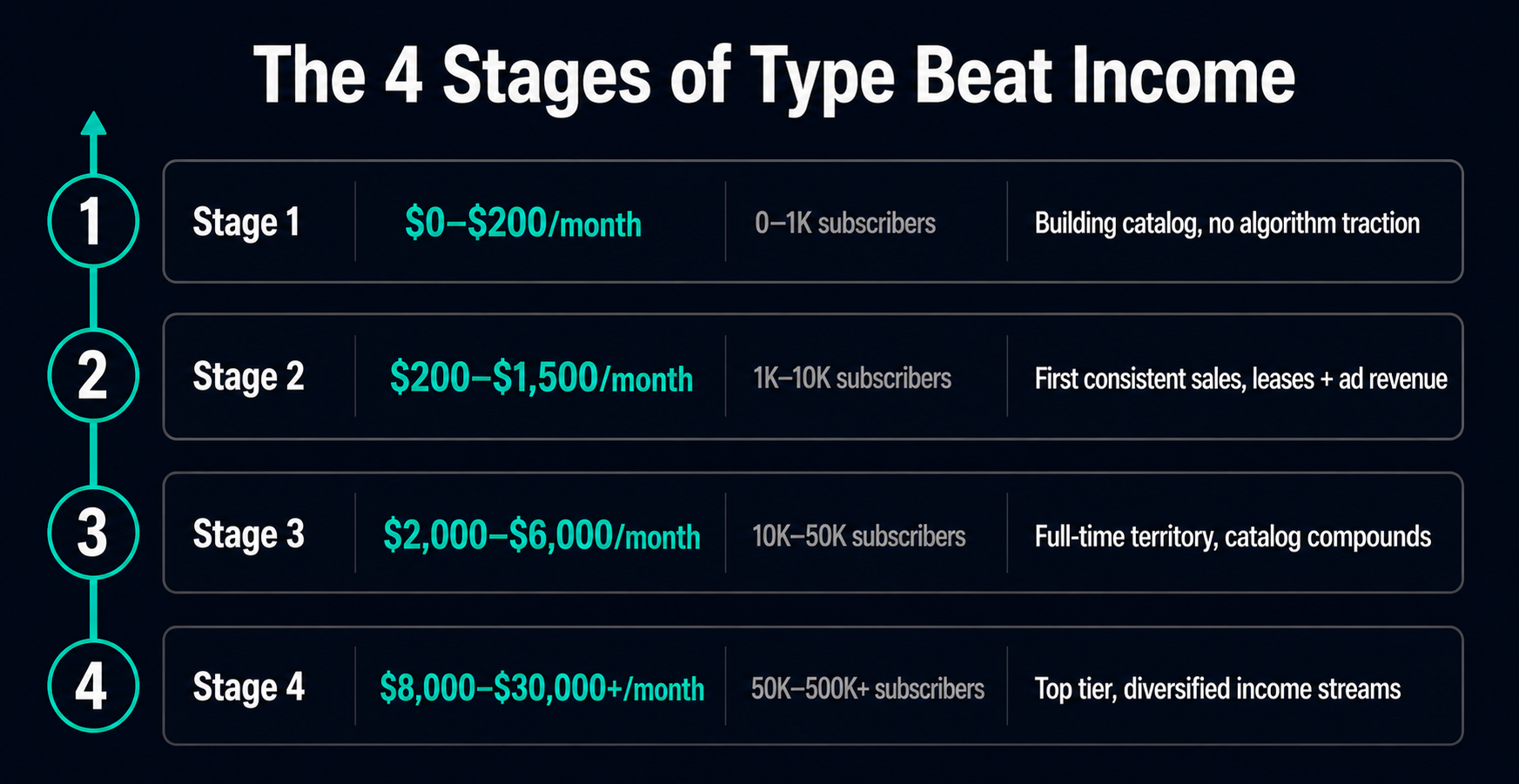
Stage 1: The First 6-12 Months (Honest Expectation: $0–$200/month)
Most producers starting out on YouTube earn almost nothing in their first year. That's not a discouraging opinion — it's the consistent picture from producer forums, Reddit threads, and income data.
Beginning producers typically earn anywhere from $0 to $500 per month, mostly from selling beats online or doing small production work. The reality for most people in this bracket: it's closer to the $0 end.
Why? Several reasons that compound on each other:
First, YouTube requires 1,000 subscribers and 4,000 watch hours to even qualify for ad revenue. New type beat channels almost never hit those thresholds in year one. Second, with no established channel, search rankings for your beats are essentially zero — you're invisible to the artists who might buy. Third, the beat pricing in this market is low. Standard non-exclusive leases (MP3 only) typically sell for around $25. Even if you make a few sales, the math doesn't add up to meaningful income at low volume.
The rare exception: producers who get lucky with one video that significantly overperforms and drives a traffic spike. It happens, but it's not a plan.
What this stage looks like in practice: Most producers in their first year are working a day job or studying, posting beats on the side, and measuring success in views and subscribers rather than dollars. The money, if it comes at all, is coffee money.
Stage 2: Growing Channel, First Consistent Sales (Realistic Range: $200–$1,500/month)
This is the stage where producers have 1,000-10,000 subscribers, a catalog of 50-150 videos, at least a few beats ranking in YouTube search for specific keyword combinations, and a BeatStars or Airbit store with some transaction history.
At this stage, the income comes from three places:
Non-exclusive lease sales. The workhorse of the type beat business. A standard non-exclusive MP3 lease goes for around $25, premium WAV leases for around $50, and tracked-out stems typically higher. If a producer is selling 15-20 leases per month at an average of $35, that's $525-$700 monthly from leases alone — before platform fees.
YouTube ad revenue. The CPM for music content on YouTube is notably low compared to finance or tech content. Type beat channels typically see RPMs (what you actually earn per 1,000 views) in the $1-3 range. A channel pulling 100,000 views per month — which is solid for a mid-stage type beat channel — would generate around $100-$300 in monthly ad revenue. It's secondary income, not a primary source.
Occasional exclusive sales. Exclusives at this stage typically sell for $150-$500 depending on the producer's reputation and the beat's performance. One or two exclusives per month can meaningfully bump total income.
What this stage looks like in practice: A producer grinding consistently, posting 3-4 beats per week, seeing real growth, and making somewhere between $400-$1,500 per month from a combination of leases, ad revenue, and the occasional exclusive. It's not full-time income in most of the world, but it's real money and it's building.
Stage 3: Full-Time Income Territory (Realistic Range: $2,000–$6,000/month)
This is where the game changes. Producers at this level typically have 10,000-50,000 subscribers, several beats ranking competitively for mid-tier and niche artist keywords, a recognizable producer name in their corner of the market, and catalog depth — 200+ published videos that collectively drive discovery.
At this scale, the math starts to work:
60-100 non-exclusive leases per month at $30-$50 average: $1,800-$5,000
YouTube ad revenue at 300,000-500,000 monthly views and $1.50-$2.50 RPM: $450-$1,250
2-4 exclusive sales per month at $300-$800 average: $600-$3,200
Total: roughly $2,850-$9,450 per month before taxes and platform fees.
With consistent output and a few thousand monthly visitors to a beat store, $40,000-$60,000 per year is achievable without label connections. Above that requires either a breakout sync hit or a move up the tier.
The top-selling producers on BeatStars at this level are moving beyond simple marketplace uploads to become multi-channel content creators who leverage YouTube and social media to drive traffic. YouTube is the engine, but the catalog depth and cross-platform presence are what sustain it.
What this stage looks like in practice: Full-time producers who have been consistently uploading for 2-4 years, who treat their channel like a business with proper SEO metadata, consistent thumbnails, and a publishing schedule. They're not necessarily the most talented producers in the room — they're the most operationally consistent.
Stage 4: The Top End (Rare, But Real: $8,000–$30,000+/month)
The top tier of the independent type beat market is a small group. These are producers with 50,000-500,000+ subscribers, multiple beats that have each accumulated millions of views, and often at least one major placement that created credibility and catalog momentum.
At this level, income diversifies further: premium exclusive pricing ($1,000-$5,000+ per exclusive), sync licensing opportunities, producer courses and mentorship products, and sometimes production deals with labels or management.
One frequently cited data point from the industry: a single hit instrumental generated $18,000 through three years of recurring leases. That's not typical — it's what happens when a beat finds genuine commercial traction. But it illustrates that non-exclusive leasing, often dismissed as small money, can compound significantly if the catalog and traffic are in place.
The Honest Math Problem Most Producers Face
Here's the uncomfortable truth that the income numbers above obscure: the gap between stage 1 and stage 3 is mostly a volume and consistency problem, not a talent problem.
A producer needs a catalog of several hundred videos, most of them properly optimized for YouTube search, with consistent thumbnails and metadata, published on a regular schedule over 2-4 years. That's what the income data says. The producers who reach $3,000-$5,000 per month aren't necessarily making better beats than the producers stuck at $200 per month. They've published more of them, packaged them better, and kept going longer.
The bottleneck isn't creative output. Most serious producers can make 10-15 beats per week. The bottleneck is everything that comes after making the beat: the video, the thumbnail, the SEO title, the description, the tags, the scheduled publishing. That packaging work takes 30-60 minutes per beat if you're doing it manually and doing it properly. At 10 beats per week, that's 5-10 hours per week of non-music work. Every week. For years.
This is exactly why tools like Typeflick exist. The platform handles the post-production pipeline — beat-to-video conversion, AI-generated thumbnails, SEO metadata, and scheduled YouTube publishing — automatically, so the packaging work doesn't cap a producer's output or force them to choose between volume and quality of optimization. The producers reaching stage 3 aren't just talented, they're publishing at scale with proper packaging on every upload. Typeflick makes that math possible without the operational grind eating every hour outside the studio.
Where the Money Actually Comes From (And What to Prioritize)
If you're thinking about income strategy, here's how to read the revenue streams:
Non-exclusive leases are your primary income driver at every stage until you have major placement history. Volume and catalog depth determine how many you sell. This is where consistent YouTube publishing compounds most directly into dollars.
YouTube ad revenue is real but secondary for most type beat channels. The CPM is low in the music niche. Think of it as a bonus on top of beat sales, not a foundation.
Exclusive sales are high-ticket but unpredictable. They happen when an artist finds a beat they want sole rights to. You can't reliably plan income around them until your channel has enough traffic to generate consistent exclusive inquiries.
Pricing: The industry consensus on a smart exclusive pricing floor comes from BeatStars founder Abe Batshon: calculate your track's 12-month lease revenue, and use that number as your baseline for exclusive pricing. If a beat has earned $500 in leases over a year, that's what the exclusive should cost at minimum. This prevents underpricing work that still has long-term lease revenue potential.
What the Income Curve Actually Looks Like
Most type beat producers follow a similar arc:
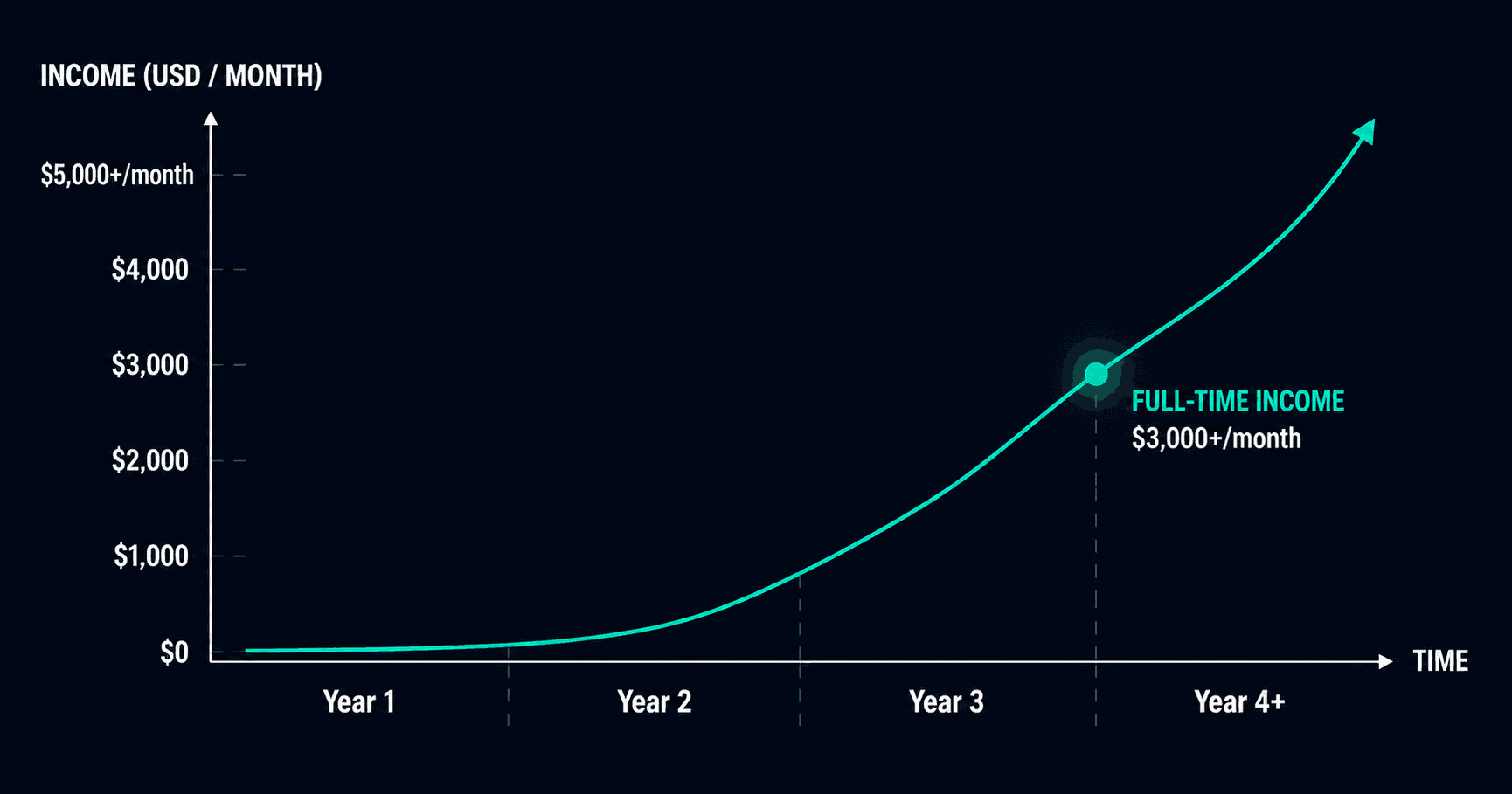
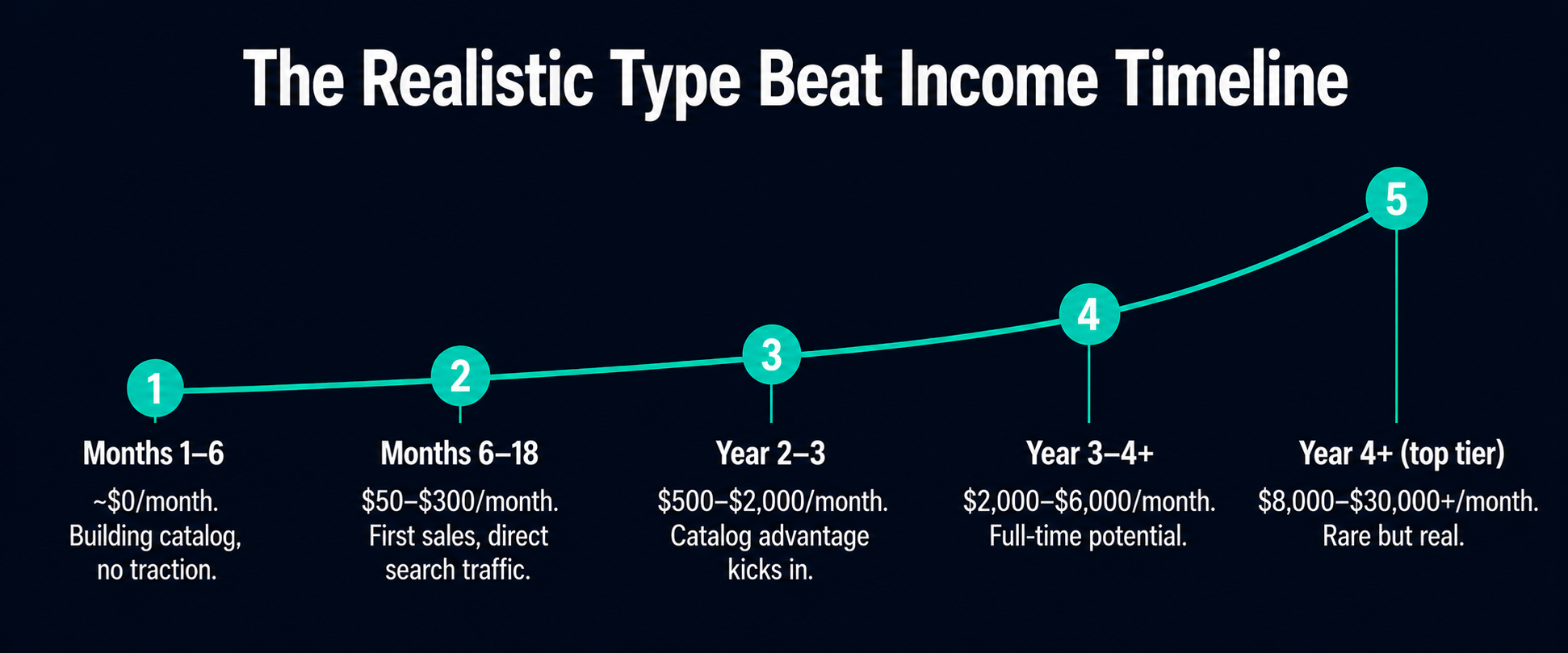 The curve is slow before it isn't. The producers who reach full-time income aren't more talented — they're the ones who didn't stop at month eight
Months 1-6: Close to $0. Building catalog, learning SEO, zero algorithm traction.
Months 6-18: First sales. $50-$300/month if uploading consistently and optimizing metadata. Channel still small, traffic mostly from direct search.
Year 2-3: First meaningful income. $500-$2,000/month for producers posting 3-4 times per week with proper packaging. This is where YouTube's catalog advantage kicks in — older videos that have accumulated views start generating passive search traffic.
Year 3-4+: Full-time potential. The producers who have maintained consistency and volume are reaching $2,000-$6,000/month. This is achievable for a serious producer, but the data shows it takes years of consistent execution, not months.
The music creator economy grew by 12% in 2022 and is projected to grow from $6 billion to $10 billion by 2030. The market is expanding. The producers who will capture that growth are the ones publishing consistently, packaging properly, and treating their channel like a long-term business.
One Number to Keep in Mind
The average successful producer earns $1,200-$5,000 per month. That range covers stage 2 through early stage 3, which is where the majority of full-time independent type beat producers actually live. It's not the dream number your favorite producer posts on Instagram — but it's real, it's liveable in most countries, and it's achievable with 2-4 years of consistent work and the right operational approach.
Getting there faster comes down to one thing: maximizing the ratio of beats published (properly packaged) to hours spent on non-music work. Every hour saved on packaging is an hour that goes back to the studio, which means more beats, more videos, more catalog depth, more search traction, and more sales.
That's the loop. Typeflick is built to make it run faster — so the gap between making a beat and having it live, optimized, and discoverable on YouTube is measured in minutes rather than hours.
Keywords: how much money do type beat producers make, type beat income 2026, BeatStars earnings, selling beats online revenue, type beat producer salary, beat lease income, YouTube type beat monetization