
AI-Generated Beat Videos and YouTube Disclosure Rules: What Producers Need to Know in 2026
If you're using any kind of AI tool to create your type beat videos — thumbnail generators, beat visualizers, background images, automated video packaging — you've probably wondered whether YouTube is going to flag your channel, penalize your monetization, or demand some kind of disclosure.
The short answer is: probably not, if you understand the actual rules. The longer answer is more nuanced, and getting it wrong costs you ad revenue, channel standing, or both. Here's the complete breakdown of what's required, what's exempt, and where the real risk sits for type beat producers in 2026.
What YouTube's AI Disclosure Policy Actually Says
YouTube's disclosure policy for AI-generated content was first announced in November 2023, formally rolled out in March 2024, and reached full mandatory enforcement on May 21, 2025. The core principle is stated clearly in YouTube's official documentation:
YouTube requires creators to disclose content that is "meaningfully altered or synthetically generated" when it seems realistic — meaning a viewer could reasonably mistake it for a real person, place, or event.
The operative word is realistic. YouTube's policy is not about whether you used AI. It's about whether the AI-generated content could deceive a viewer into thinking something fake is real.
This distinction matters enormously for type beat producers.
The Two Separate Compliance Tracks
Before getting into the specific implications for beat channels, it's important to understand that YouTube runs two separate policies that often get confused:
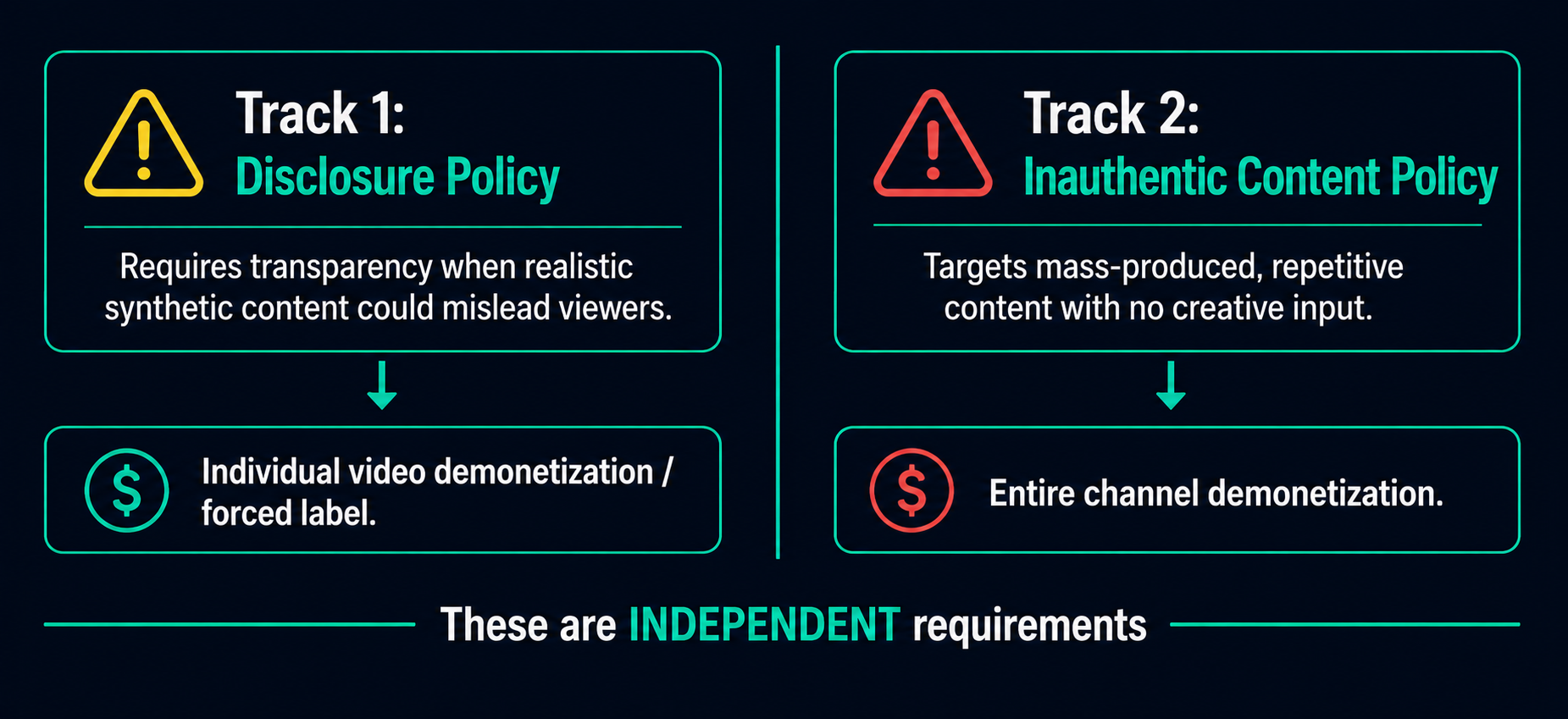
Track 1: The Disclosure Policy — requires transparency when realistic synthetic content could mislead viewers. Violation can result in forced labeling, demonetization, or content removal.
Track 2: The Inauthentic Content Policy — targets mass-produced, repetitive content with no genuine human creative input. Violation results in demonetization of the channel as a whole, not just individual videos.
A channel can comply perfectly with Track 1 (properly disclosing AI use) and still get penalized under Track 2 (if the content is templated, low-effort, and indistinguishable from video to video). They are independent compliance requirements.
What Triggers the Disclosure Requirement
According to YouTube's official policy, you are required to enable the "Altered or Synthetic Content" toggle in YouTube Studio when your video includes:
Synthetic or cloned voices that realistically replicate a real person — for example, using an AI voice model to make it sound like a real artist is speaking or performing in your video.
Digitally manipulated visuals that show a real person saying or doing something they never actually did — deepfake-style footage, realistic AI-generated versions of real people.
Fabricated real-world events — AI-generated footage designed to look like genuine documentary evidence of events that never happened, realistic news-style segments, etc.
Realistic scenes of real places that could be mistaken for actual footage of those locations — for example, a photorealistic AI-generated cityscape presented as real B-roll.
The disclosure toggle lives in YouTube Studio, under the Details section of the upload flow. Under "Altered content," selecting "Yes" automatically generates a label in the video's expanded description under "How this content was made." The process takes under 30 seconds.
What Does NOT Require Disclosure
This is the part most type beat producers need to read carefully, because the majority of AI tools used in beat video production fall into the exempt category.
YouTube explicitly states that creators do not need to disclose when:
AI was used for production assistance — this includes scripts, captions, thumbnails, video editing, and metadata generation. None of this triggers the disclosure requirement.
Content is clearly unrealistic or stylized — animated visualizers, abstract motion graphics, illustrated thumbnails, stylized backgrounds. If no reasonable viewer would mistake it for real-world footage of a real person or event, no disclosure needed.
AI tools added minor enhancements — color correction, image upscaling, noise reduction, visual filters. These are treated as standard production tools.
Using YouTube's own built-in AI features — tools like DreamScreen automatically apply the disclosure for you. No manual step required.
According to YouTube's own Help Center and confirmed by multiple policy analyses: "Adding an AI-generated cover image (thumbnail), background music, or sound effects to an otherwise live-action video does not require disclosure."
The Specific Situation for Type Beat Channels
Let's map the policy directly to what type beat producers actually do.
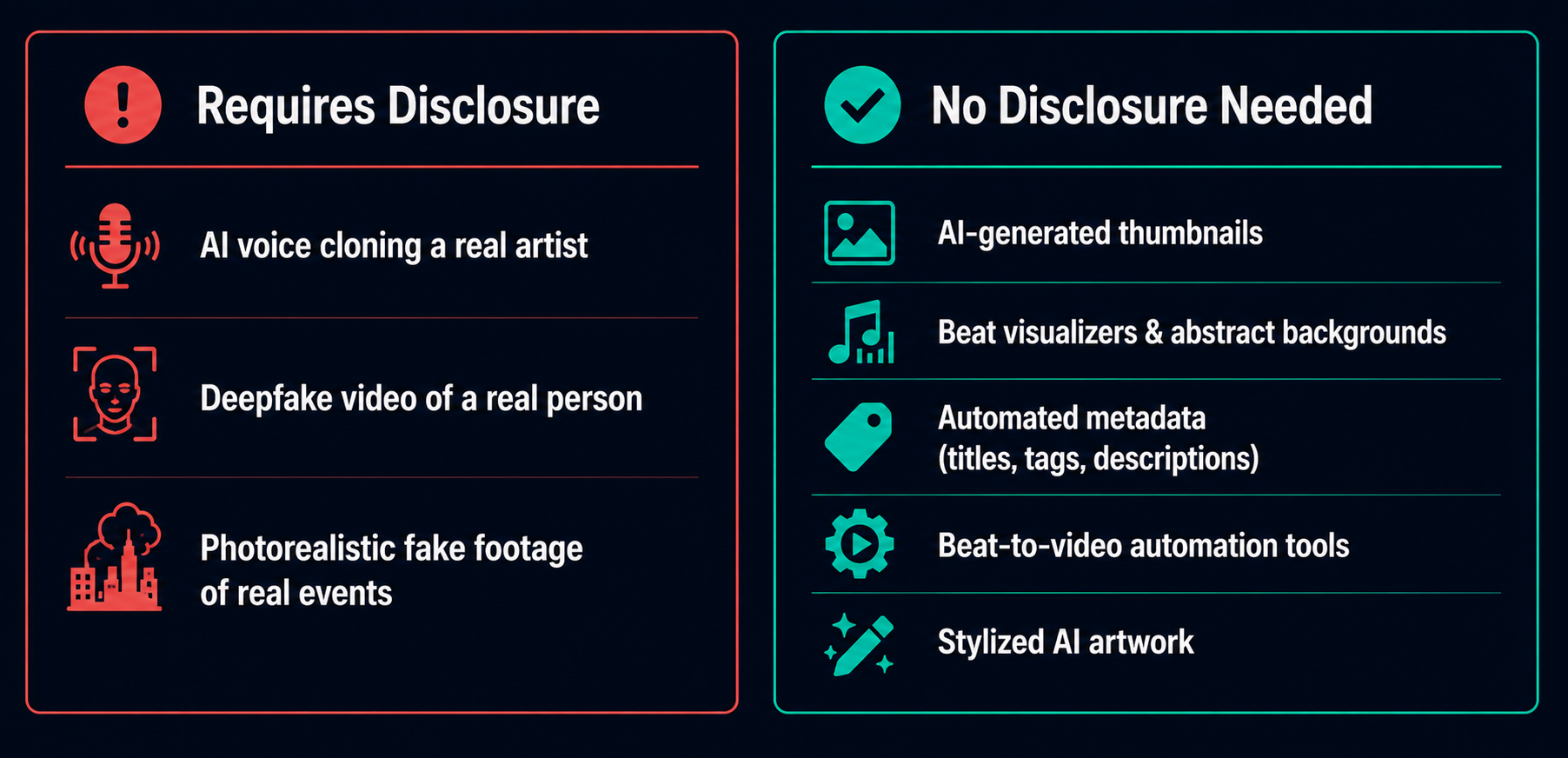 For most type beat producers, every standard workflow falls in the right column. The left column requires deliberate effort to trigger.
AI-Generated Thumbnails
No disclosure required.
An AI-generated thumbnail is production assistance. Even a highly realistic AI-generated image used as a thumbnail does not trigger the disclosure requirement, because it's not presenting synthetic footage as real-world video content. The policy specifically exempts thumbnail generation from disclosure requirements.
One caveat: if your thumbnail realistically depicts a named real artist doing something fabricated — not a stylized illustration, but a photorealistic depiction designed to look like actual footage — that enters murkier territory. Standard type beat thumbnail formats (artist photos sourced from press releases, stylized AI visuals, abstract backgrounds) are entirely outside the disclosure requirement.
AI-Generated Beat Visualizers and Video Backgrounds
No disclosure required in most cases.
If your beat video is a static or animated visual over the audio — waveform visualizers, abstract motion graphics, AI-generated artwork, particle effects — none of this triggers disclosure. These are clearly stylized, clearly not attempting to pass as real-world footage of real events.
The exception would be if you used AI to generate a photorealistic video that looks like genuine footage of real people or places. A standard type beat video with an AI-generated atmospheric background, an animated visualizer, or AI artwork is not this.
Beat-to-Video Automation Tools
No disclosure required.
Tools that take your audio file and produce a formatted YouTube video — packaging the beat with a visual, generating metadata, scheduling publication — are production assistance tools. The automation of packaging workflow doesn't generate synthetic realistic content. The resulting video is your beat with a visual, which is exactly what a manually-packaged type beat video is.
This is specifically the workflow that Typeflick handles — beat-to-video conversion, AI thumbnail generation, automated metadata, scheduled publishing. None of this output meets the threshold that triggers YouTube's disclosure requirement.
AI Voice Narration in Videos
Depends on implementation.
If you use an AI voice to narrate or introduce your beat (saying "Drake type beat by [your producer name]," for example), disclosure isn't automatically required — unless the AI voice is specifically designed to realistically clone a real person's voice. A generic AI narrator voice doesn't require disclosure. An AI voice that sounds like Drake does.
In practice, most type beat videos have no voiceover at all — just the beat, the visual, and the title card. The voice narration question is largely irrelevant for the standard format.
The Real Risk: The Inauthentic Content Policy
The disclosure policy is straightforward for type beat producers — most standard workflows fall in the exempt category. The bigger risk sits with Track 2.
On July 15, 2025, YouTube renamed its "repetitious content" policy to "inauthentic content" and updated the guidelines to better identify mass-produced, template-based videos. The official language from YouTube's Help Center:
"Inauthentic content refers to mass-produced or repetitive content. This includes content that looks like it's made with a template with little to no variation across videos, or content that's easily replicable at scale."
"This policy applies to your channel as a whole. If you have videos that violate our guidelines, monetization may be removed from your entire channel."
This is the policy that got thousands of faceless AI channels demonetized or suspended in early 2026. The channels that got hit shared a consistent pattern: same visual template on every video, same structure, same formatting, synthetic voiceover with no tonal variation, zero original editorial layer.
The key distinction YouTube draws: if the average viewer can clearly tell that content on your channel differs from video to video, you're fine to monetize. YouTube is anti-lazy, not anti-AI.
For type beat channels, this policy creates a real tension. Type beats are structurally similar by nature — artist photo or visual, beat playing, title card. But there's an important difference between:
Problematic: 200 videos that are literally identical in format, same template, same layout, same background, same everything — just different audio. No variation, no creative differentiation, clearly automated.
Fine: A consistent visual identity across your catalog (same color system, same font, similar layout) but with variation in the imagery, artistic direction in thumbnails, genuine variation in the production that reflects creative decision-making. The consistency is intentional branding, not machine-generated templating.
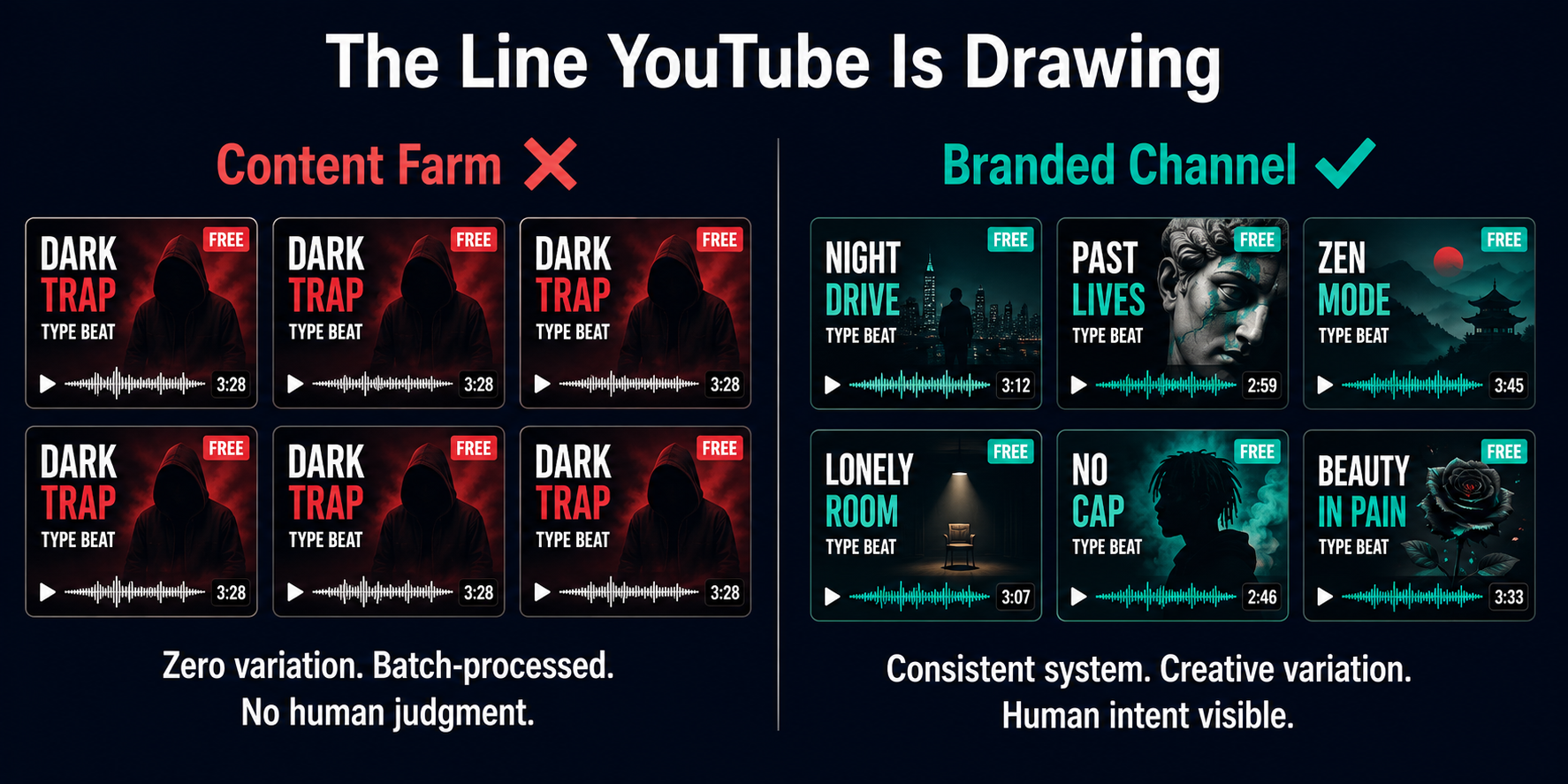
The line YouTube is drawing is between a visual system built with creative intent and a batch-processed template with zero human judgment applied. Your channel looking consistent is not the problem. Your channel looking like a content farm is.
What Happens If You Don't Comply
For the disclosure policy, non-compliance with the toggle requirement on content that genuinely requires it can result in:
YouTube proactively applying its own label to your video (one you cannot remove)
Policy strikes against your channel
Demonetization of individual videos
In serious cases involving deceptive synthetic content: content removal
For the inauthentic content policy, YouTube has been explicit that violations can result in monetization being removed from the entire channel — not just flagged videos.
YouTube also uses automated detection systems that scan uploads for undisclosed synthetic content. If their system identifies what it believes is realistic AI-generated content that hasn't been disclosed, it can act without a creator report triggering it.
The Practical Compliance Checklist for Type Beat Producers
You almost certainly don't need to disclose if:
Your videos are beats with AI-generated or manually-created visuals (artwork, abstract backgrounds, waveform visualizers)
Your thumbnails are AI-generated
Your metadata (titles, descriptions, tags) was generated or assisted by AI
Your beat video packaging was automated
Your visual identity is consistent across your catalog using a template system
You do need to disclose if:
Your video contains a synthetic voice designed to realistically clone a specific real person
Your video contains AI-generated video footage of real people doing or saying things they never did
Your video contains photorealistic AI-generated footage designed to look like real-world documentary evidence of events
You need to ensure your channel doesn't look like a content farm:
Some variation in visual presentation across videos (even within a consistent brand system)
Thumbnails that reflect creative decision-making, not batch-processed identical outputs
Evidence of human judgment in the catalog — the algorithm is looking for this
The Big Picture
YouTube's message in 2026 is consistent across every policy update: the platform actively supports AI as a creative tool. Over 20 million users used YouTube's own AI features in a single month in late 2025. What YouTube is against is deception and laziness — using AI to mislead viewers about reality, or to flood the platform with zero-effort content that exists purely to accumulate views.
For a type beat producer using AI tools to package and publish music they actually made, the risk is low and the compliance path is simple. Make real beats. Use AI to help with the packaging. Don't clone real people's voices or fabricate video of real events. Ensure your catalog reflects genuine creative variation rather than pure templated repetition.
That's it. The rest is noise.
Keywords: YouTube AI disclosure rules 2026, AI generated beat videos YouTube policy, type beat channel monetization AI, YouTube altered synthetic content toggle, YouTube inauthentic content policy beats, AI thumbnail disclosure YouTube